
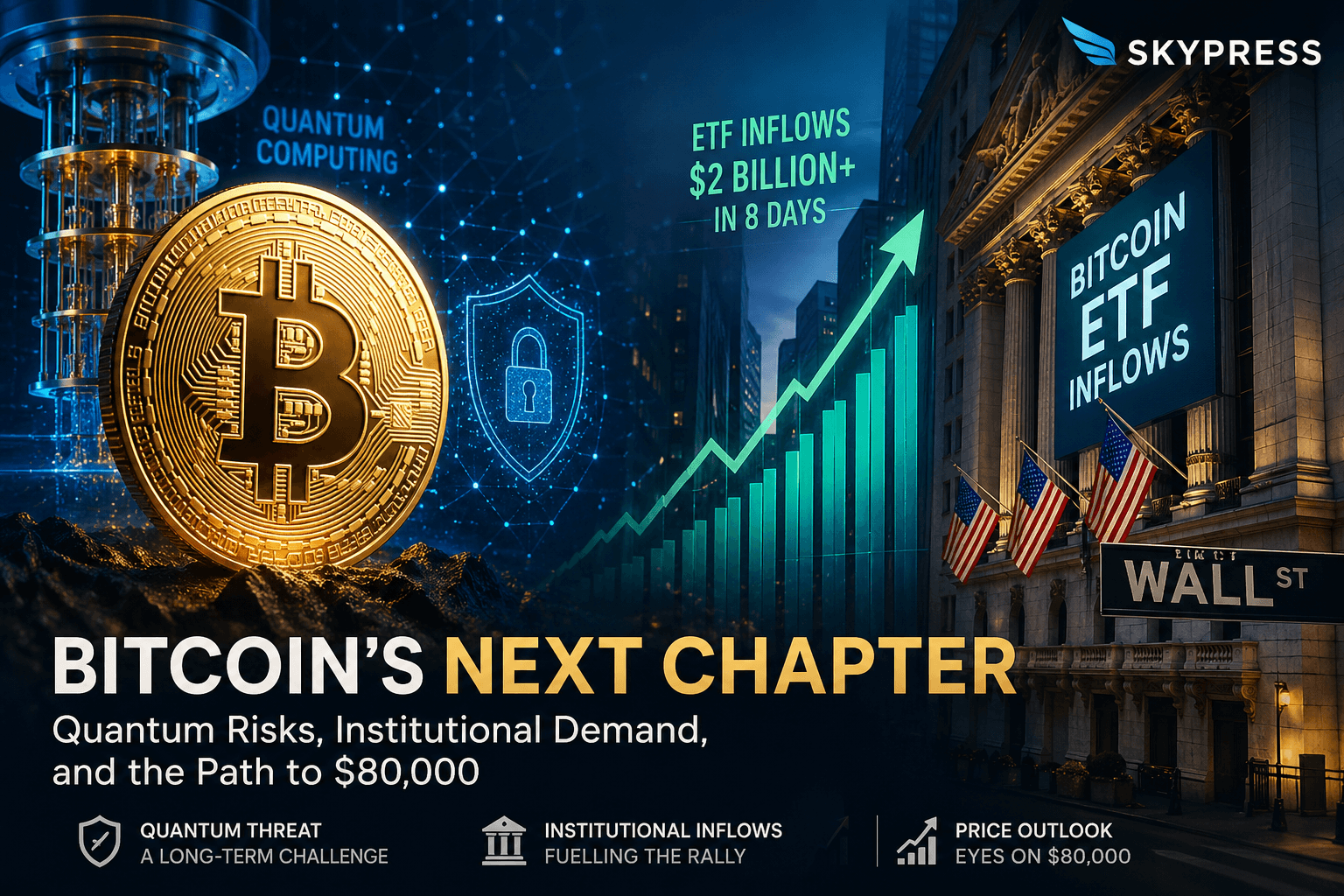
Bitcoin Nears $80,000 as ETF Inflows Accelerate and Quantum Risks Come Into Focus

Key Takeaways
- U.S. spot Bitcoin ETFs recorded eight consecutive sessions of net inflows through April 23.
- The eight-session inflow total reached approximately $2.1 billion, according to SoSoValue data cited in market reporting.
- Bitcoin was trading around the $77,000 area on April 24, bringing the $80,000 level into focus for market participants.
- A researcher demonstrated a 15-bit elliptic-curve attack on publicly accessible quantum hardware.
- The quantum demonstration did not break Bitcoin’s 256-bit cryptography, but it renewed discussion about future migration to quantum-resistant security.
April 24, 2026 — SkyPress: Bitcoin is approaching the $80,000 mark as renewed demand through U.S. spot exchange-traded funds coincides with a fresh development in the debate over quantum computing and cryptocurrency security.
The two developments represent very different time horizons for the Bitcoin market. ETF flows are an immediate indicator of investor demand and capital allocation, while quantum computing remains a longer-term technological issue. Bringing the two stories together provides a useful picture of where Bitcoin stood on April 24: stronger institutional-market participation on one side, and an evolving security debate on the other.
Bitcoin ETF Demand Extends Eight-Day Inflow Streak
U.S. spot Bitcoin ETFs recorded their eighth consecutive day of net inflows through April 23, with the combined inflows reaching approximately $2.1 billion. The streak was the longest since a nine-session run recorded in October 2025.
Data reported from SoSoValue showed that the ETFs attracted approximately $223.21 million on April 23 alone. BlackRock’s iShares Bitcoin Trust, known by its ticker IBIT, accounted for about $167.49 million of that day’s inflow, while Fidelity’s FBTC recorded an outflow of approximately $16.93 million.
The figures indicate that regulated exchange-traded products remained an important channel through which investors were gaining exposure to Bitcoin. They do not, by themselves, establish that all ETF purchases represent long-term institutional conviction, nor do they guarantee that the buying trend will continue.
What the ETF Numbers Actually Show
ETF inflows provide a measurable view of net capital entering the spot Bitcoin fund category. They are useful for understanding demand through regulated investment vehicles, but they should not be interpreted in isolation.
Bitcoin’s price can also be affected by derivatives positioning, exchange liquidity, macroeconomic conditions, profit-taking, geopolitical developments and changes in risk appetite. A period of strong ETF inflows can therefore occur alongside selling by other market participants.
That distinction matters as Bitcoin approaches major price levels. Strong fund inflows describe one part of the market; they do not remove the possibility of volatility or reversal.
Why $80,000 Has Become an Important Market Threshold
With Bitcoin trading around $77,000 on April 24, the $80,000 level had become an obvious psychological threshold for traders and investors monitoring the rally.
Market analysis cited around the time placed Bitcoin’s short-term holder cost basis near $80,100. That level was being watched because a sustained move above it could change the profit-and-loss position of a significant portion of recent buyers.
At the same time, the presence of substantial recent gains means the market could face profit-taking if holders decide to reduce exposure. Consequently, the area around $80,000 was better viewed as a level to monitor than as a predetermined destination for Bitcoin.
The Difference Between Momentum and Confirmation
The ETF inflow streak and Bitcoin’s recovery from approximately $68,000 provide evidence of stronger demand during the period under review. Confirmation of a longer-lasting trend, however, would require observing whether inflows persist, whether market liquidity remains healthy and whether Bitcoin can hold higher price levels after periods of profit-taking.
For SkyPress readers, the distinction is important: a strong short-term rally is a market development, not proof that the next price move is already determined.
Quantum Computing Brings a Different Kind of Bitcoin Risk
While ETF flows are influencing Bitcoin’s market narrative in the present, developments in quantum computing raise a very different question: how long can today’s cryptographic protections remain secure against increasingly capable quantum machines?
Bitcoin relies on elliptic-curve cryptography for digital signatures. In practical terms, the system allows users to prove control over Bitcoin without revealing their private keys. A sufficiently powerful quantum computer running an algorithm such as Shor’s algorithm could eventually challenge that protection.
That threat remains a future technological concern rather than a demonstrated ability to steal Bitcoin from ordinary wallets today.
A 15-Bit Demonstration Shows Progress, Not a Bitcoin Break
On April 24, independent researcher Giancarlo Lelli was awarded Project Eleven’s Q-Day Prize after demonstrating an attack against a 15-bit elliptic-curve key using publicly accessible quantum hardware.
The demonstration was significantly larger than the previous publicly reported 6-bit demonstration in 2025. However, Bitcoin uses elliptic-curve cryptography at a vastly larger 256-bit scale. The April 24 experiment therefore did not demonstrate that Bitcoin’s current cryptography can be broken.
Important distinction
A successful attack on a small experimental elliptic-curve key is not equivalent to breaking Bitcoin. The significance of the April 24 demonstration is that researchers are continuing to test the practical limits of quantum attacks against cryptographic systems.
Why Exposed Public Keys Matter
The quantum discussion is particularly relevant to Bitcoin addresses whose public keys are already exposed on-chain. Estimates cited in contemporary reporting put the amount of Bitcoin associated with such addresses at roughly 6.9 million BTC.
This does not mean that those coins are currently vulnerable to a practical quantum attack. Instead, the figure illustrates why developers, researchers and custodians are discussing potential migration toward quantum-resistant cryptographic systems before sufficiently powerful quantum computers become available.
Bitcoin’s Security Challenge Is a Long-Term Question
Moving a global blockchain to new cryptographic standards would involve technical development, software upgrades, wallet compatibility, exchanges, custodians and broad agreement among participants in the network.
That makes quantum security different from an ordinary market catalyst. ETF flows can be measured from one trading session to the next, whereas cryptographic migration involves years of research, testing and coordination.
For Bitcoin investors and users, the relevant question is therefore not whether quantum computers have broken Bitcoin today. They have not. The more important question is how the ecosystem prepares for a future in which quantum capabilities become substantially more powerful.
Market Context: What Bitcoin Traders Were Watching
As of April 24, three themes were particularly relevant to Bitcoin’s market narrative:
- ETF flows: Whether the eight-session inflow streak would continue.
- Price structure: Whether Bitcoin could sustain levels near the $77,000 area and challenge the $80,000 threshold.
- Technology risk: Whether advances in quantum computing would accelerate discussions around post-quantum Bitcoin security.
These developments should not be treated as a single bullish or bearish signal. They represent different parts of Bitcoin’s evolving market and technological landscape.
ETF flows provide information about capital entering or leaving regulated investment products. Quantum research provides information about a potential long-term technological challenge. Neither development, by itself, determines Bitcoin’s future price.
Sources & Reporting
SkyPress independently researched and synthesized this article using reporting and market information available around April 24, 2026. The article is not reproduced from any single source.
- CoinDesk — Reporting published April 24, 2026 on Giancarlo Lelli’s 15-bit elliptic-curve demonstration, Project Eleven’s Q-Day Prize and the distinction between the demonstration and Bitcoin’s 256-bit cryptographic security.
- SoSoValue data — ETF flow data cited in contemporary market reporting concerning U.S. spot Bitcoin ETF inflows through April 23, 2026.
- Contemporary cryptocurrency and market reporting — Information concerning Bitcoin’s price movement, ETF activity and the wider discussion surrounding quantum-related cryptocurrency security.
Editorial note: SkyPress uses external reporting and publicly available data as research inputs, then independently structures and writes its coverage. Market figures can change rapidly, and readers should refer to the original data providers for subsequent updates.
Article Disclaimer
This article is provided for general informational and educational purposes only. It does not constitute financial, investment, trading, legal, tax, or other professional advice. Cryptocurrency and other digital assets are highly volatile and involve substantial risk, including the possible loss of capital. Market commentary, price levels, ETF flows and other information presented in this article are not guarantees of future performance or outcomes. Readers should conduct their own research and, where appropriate, consult a qualified professional before making financial decisions. SkyPress does not guarantee the accuracy, completeness, or continued availability of third-party information and accepts no responsibility for losses arising from reliance on this material.