

Global Markets Under Pressure as Fed Holds Rates, Dollar Debate Intensifies & Asia Reacts

Global Markets on Edge as Fed Signals Pause, Dollar Debate Intensifies, and Asia Reacts to Middle East Tensions
By SkyPress News Desk | April 2026
Introduction: A Fragile Global Economic Balance
Global financial markets are navigating a period of heightened uncertainty as geopolitical tensions, monetary policy dilemmas, and shifting currency dynamics converge. From the U.S. Federal Reserve’s cautious stance on interest rates to renewed debate over the future of the U.S. dollar and volatile movements across Asian markets, investors are facing a complex and evolving landscape.
At the center of this uncertainty lies the ongoing Middle East conflict—particularly the Iran war—which continues to ripple across energy markets, inflation expectations, and global investor sentiment. While diplomatic signals hint at possible de-escalation, the economic consequences remain far from resolved.
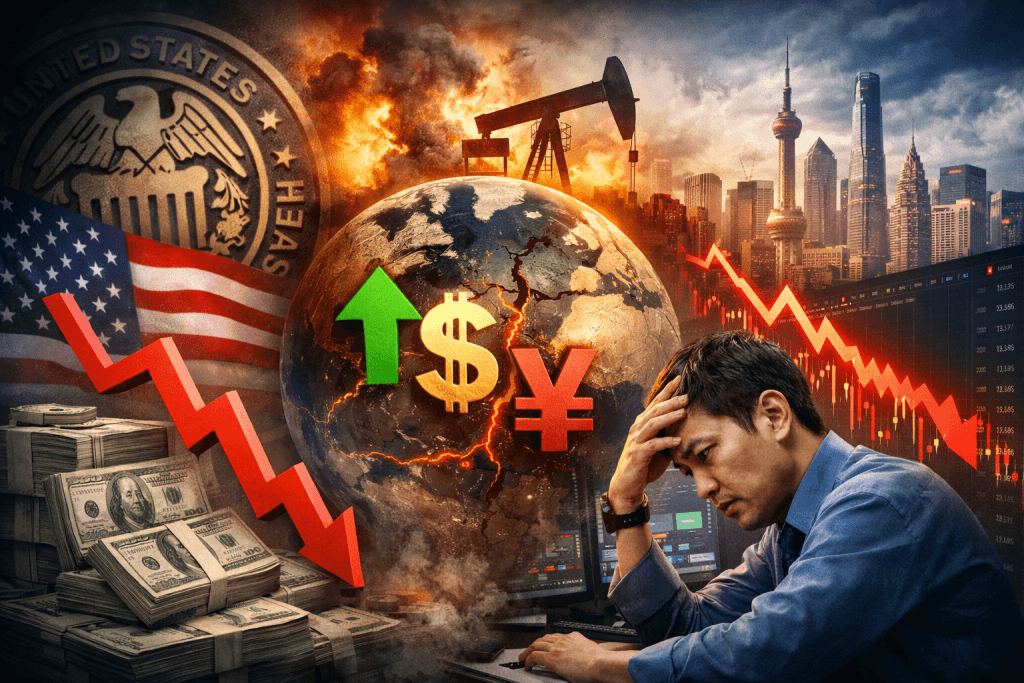
Federal Reserve Faces Policy Dilemma Amid Inflation and Labor Market Risks
The U.S. Federal Reserve finds itself in a difficult position as it balances persistent inflation risks against a fragile labor market. Federal Reserve Governor Christopher Waller recently highlighted the growing complexity of monetary policy in the current environment.
According to Waller, policymakers may need to maintain interest rates at current levels for an extended period as they assess competing risks.
“High inflation and a weak labor market would be very complicated for a policymaker.”
This reflects a broader concern within the Fed: the possibility of a stagflation-like scenario, where inflation remains elevated while economic growth and employment weaken.
A Shift in Labor Market Assessment
Waller’s latest remarks mark a subtle shift in tone regarding the labor market. While earlier concerns focused on declining hiring activity, recent data suggests that the economy may be operating near a “break-even” employment level—where hiring is just enough to keep unemployment stable.
However, this stability may be deceptive.
Employers are walking a tightrope, balancing past labor shortages with growing uncertainty about future economic conditions. This precarious position leaves businesses vulnerable to external shocks, particularly those stemming from geopolitical tensions or sudden demand shifts.
Inflation Risks Still Loom Large
On inflation, Waller expressed greater concern than some of his peers. While others believe the inflationary impact of the Iran conflict will be temporary, repeated price shocks—combined with lingering effects from tariffs—could lead to a more sustained rise in inflation.
This echoes patterns seen during the COVID-19 pandemic, where multiple shocks compounded into prolonged price pressures.
As a result, the Fed may prioritize controlling inflation over stimulating employment, reinforcing expectations that interest rate cuts could remain off the table in the near term.
Markets Brace for a Prolonged “Wait-and-See” Approach
Financial markets are increasingly aligning with the view that the Federal Reserve will remain on hold throughout the year. The benchmark federal funds rate currently sits within a range of approximately 3.5% to 3.75%, and policymakers appear reluctant to shift direction without clearer economic signals.
This cautious stance reflects not only domestic concerns but also global uncertainties, particularly those tied to energy markets and geopolitical developments.
For investors, this translates into a prolonged period of policy ambiguity, where data-driven volatility is likely to dominate market behavior.
Dollar Dominance Questioned as ‘Petroyuan’ Debate Resurfaces
While monetary policy remains in focus, another critical debate is unfolding in currency markets: the future of the U.S. dollar as the world’s dominant reserve currency.
The Rise of the ‘Petroyuan’ Narrative
Some analysts argue that the current geopolitical environment could accelerate a transition away from dollar-based oil pricing—a system often referred to as the “petrodollar.”
In its place, the concept of a “petroyuan” has emerged, suggesting that countries may begin pricing oil in Chinese yuan instead of U.S. dollars.
Counterarguments: No Real Alternative—Yet
However, many experts remain skeptical that the dollar’s dominance is under immediate threat.
- Deep and highly liquid capital markets
- Strong legal and institutional frameworks
- Global trust in dollar-denominated assets
- Full currency convertibility
These factors make it extremely difficult for any single currency—including the Chinese yuan or the euro—to replace the dollar in the near term.
A Middle Ground: Gradual Erosion, Not Collapse
Rather than a sudden shift, many analysts foresee a gradual erosion of the dollar’s dominance. While it may weaken structurally, it is expected to remain central to global trade and finance.
Asia Markets Slide Despite Wall Street Strength
Across Asia-Pacific markets, investor sentiment has turned cautious, even as U.S. equities continue to reach record highs.
Regional Market Performance
- Japan’s Nikkei 225 fell after recent highs
- Hong Kong’s Hang Seng Index declined
- South Korea’s Kospi posted losses
- China markets remained slightly negative
- India’s Nifty 50 showed modest gains
Wall Street Resilience Continues
- S&P 500 and Nasdaq reached record levels
- Nasdaq posted longest winning streak since 2009
- Dow Jones Industrial Average continues upward trend
Middle East Developments Drive Market Volatility
Ceasefire Hopes Offer Temporary Relief
- Temporary ceasefire between Israel and Lebanon announced
- U.S.-Iran talks may resume soon
- Leaders signal optimism but timelines unclear
Oil Prices React to Uncertainty
Energy markets have been highly sensitive to geopolitical developments, with crude oil prices fluctuating sharply amid supply concerns and easing slightly on hopes of de-escalation.
Currency and Energy Markets: A Tight Interconnection
The relationship between oil prices and currency markets has strengthened significantly. Rising energy prices tend to increase inflation and currency volatility, while declining prices may ease pressures but signal weaker demand.
Japan and Regional Policy Responses
Japan has introduced measures to support regional energy security, while central banks across Asia continue to monitor exchange rates, inflation, and capital flows closely.
The Bank of Japan has emphasized maintaining accommodative policy conditions due to persistently low real interest rates.
Investor Outlook: Navigating Uncertainty
Key Risks
- Geopolitical tensions
- Persistent inflation
- Central bank uncertainty
- Currency volatility
Potential Opportunities
- Strong U.S. equity momentum
- Currency diversification
- Energy market positioning
Conclusion: A World in Transition
The global economy is entering a period of transition, shaped by geopolitical shifts, evolving monetary policy, and changing currency dynamics.
While the U.S. dollar remains dominant, its long-term trajectory is increasingly being questioned. At the same time, central banks are grappling with complex trade-offs that could define the next phase of economic growth.
As uncertainty persists, one thing remains clear: the path forward will be anything but predictable.