
Learn Risk Management & Psychology: The Trader’s Mindset
Master the Art of Forex Trading With Discipline, Strategy & Confidence
Learn powerful risk management techniques, develop emotional discipline, and build a resilient trader mindset designed for long-term success in the forex market.
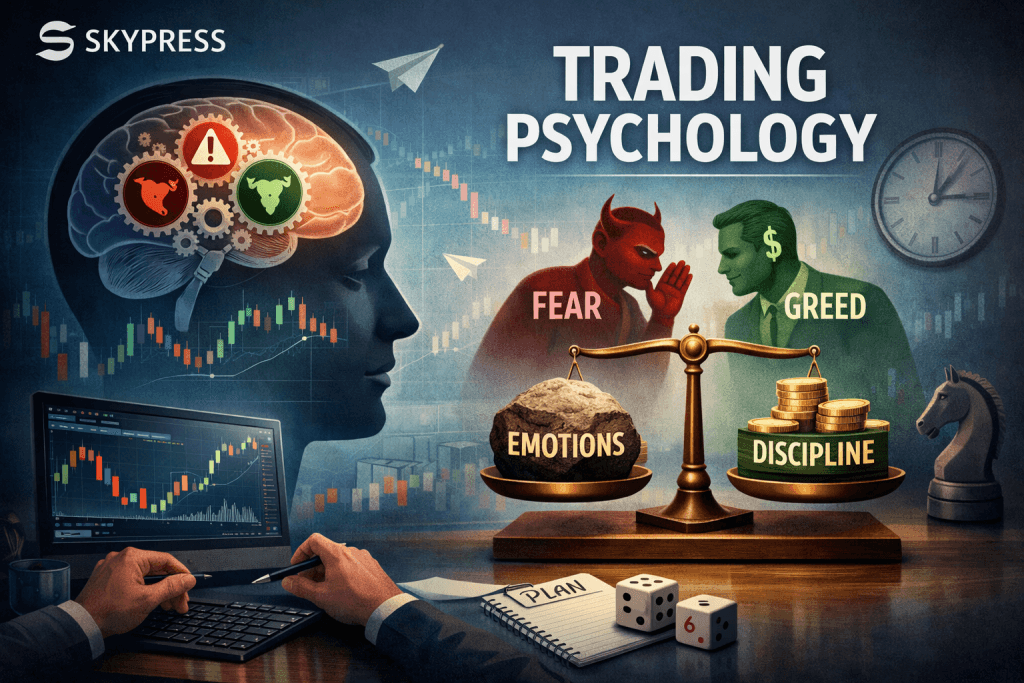
The Core of Forex Success
At SkyPress, we have observed a recurring pattern among traders: those who succeed are not necessarily the ones with the most complex algorithms or the highest IQ. Instead, they are the ones who have mastered themselves. While technical skills and market analysis are vital, they are only half the equation. The true differentiator between a novice and a professional trader lies in risk management and trading psychology.
Many traders fail not because they lack technical skills, but because they cannot control their emotions. The market is an unpredictable environment, and without a solid mental framework and strict capital preservation rules, even the best strategy will eventually lead to ruin. In this guide, we will explore the practical application of these concepts to help you build the resilience needed for the long haul.
Risk Management Essentials
Preserving capital is the first rule of trading. Before you can grow your account, you must protect it. At SkyPress, we teach that managing your money is just as important as managing your trades. Here are the three pillars of effective risk management:
1. Position Sizing
Position sizing is the art of determining exactly how much capital to allocate to a single trade. It is not about how much you can trade, but how much you should trade based on your account size and risk tolerance.
A common mistake among beginners is risking too much of their account on a single setup. We recommend risking a small, fixed percentage (typically 1% to 2%) of your total capital per trade. This ensures that a string of losses—which is inevitable in forex trading—will not wipe out your account.
2. Stop-Loss Orders
A stop-loss order is a pre-determined instruction to close a position at a specific price level to limit downside. It is your safety net.
Many traders view stop-losses as a sign of defeat, but in reality, they are a tool of discipline. By setting a stop-loss, you remove the emotional decision-making from the exit process. The market moves fast, and hesitation can be costly. Automating your exit strategy protects your capital and allows you to sleep soundly at night.
3. Risk-Reward Ratio
The risk-reward ratio measures the potential profit of a trade against its potential loss. For example, if you risk $100 on a trade with the potential to make $300, your risk-reward ratio is 1:3.
We advise our students to aim for ratios of at least 1:2 or higher. This means that even if you are only right 50% of the time, you will still be profitable in the long run. Focusing on high-quality setups with favorable risk-reward ratios is a cornerstone of capital preservation.
Mastering Trading Psychology

The mental game is often the hardest to master. The market is a reflection of human psychology—fear, greed, hope, and panic. To succeed, you must understand how these emotions influence your decision-making.
Greed and Fear
Greed leads to overtrading and taking unnecessary risks, while fear causes you to exit winning trades too early or avoid valid setups altogether. Both emotions disrupt a solid trading plan. The key is to recognize these feelings without letting them dictate your actions.
Overtrading
Overtrading is a symptom of emotional instability. It often occurs after a loss (revenge trading) or a win (euphoria). Sticking to your predefined criteria for entering a trade is essential. Quality always trumps quantity in forex trading.
Emotional Control & Discipline
Discipline is the bridge between goals and accomplishment. It is the ability to follow your plan even when no one is watching—or when the market is testing your resolve.
Sticking to Your Trading Plan
Your trading plan is your business plan. It outlines your entry and exit criteria, risk parameters, and market analysis methods. Without a plan, you are gambling. With a plan, you are running a business. We emphasize the importance of maintaining a trading journal to track your performance and reinforce discipline.
Patience
Patience
Patience is a virtue in trading. You do not need to be in the market every second of the day. The most successful traders wait for high-probability setups that align with their strategy. As Warren Buffett famously said:
“The most important quality for an investor is temperament, not intellect.” — Warren Buffett
This quote holds profound truth for forex traders. A calm, patient temperament allows you to wait for the right opportunity rather than forcing a trade out of boredom or anxiety.
Emotional Detachment
Treating trading as a business, not a casino, is the ultimate form of emotional detachment. When you view each trade as a statistical experiment rather than a personal victory or defeat, you remove the emotional weight from your decisions. This mindset shift is crucial for maintaining consistency.
Capital Preservation & Long-Term Resilience
At SkyPress, we teach that managing your mind is just as important as managing your money. This module helps you build the resilience needed for the long haul.
The Psychology of Loss
Losses are an integral part of trading. Even the best traders experience drawdowns. The psychological impact of a loss can lead to a downward spiral if not managed correctly. By accepting that losses are a business expense, you can detach emotionally and move on to the next trade with a clear head.
Building Resilience
Resilience is built through consistent practice and adherence to your risk management rules. When you prioritize capital preservation, you reduce the stress associated with trading. This, in turn, improves your decision-making process.
Practical Application
To put this into practice, we recommend the following steps:
- Define Your Risk: Determine the maximum percentage of your capital you will risk per trade.
- Set Your Stops: Always use a stop-loss order based on technical analysis, not arbitrary numbers.
- Calculate Ratios: Before entering a trade, ensure the potential reward justifies the risk.
- Review Your Journal: Regularly analyze your trades to identify emotional patterns and improve discipline.
Conclusion
Mastering risk management and trading psychology is a journey, not a destination. It requires continuous learning, self-reflection, and discipline. By focusing on these core elements, you can build a sustainable trading career that withstands the test of time.
At SkyPress, we are committed to providing you with the tools and knowledge needed to succeed. Whether you are just starting or looking to refine your skills, our comprehensive resources are designed to support your growth.
To further your education, we invite you to explore our related pages:
- Start with the basics in our Forex Trading Basics guide.
- Learn how to analyze the market in our Technical and Fundamental Analysis page.
- Dive deeper into our comprehensive Forex Trading Full Course.
Remember, the most successful traders are not those who take the most risks, but those who manage them best. Trade smart, stay disciplined, and let SkyPress guide you to success.
Disclaimer:
This article is for educational and informational purposes only and does not constitute financial or investment advice. Forex trading involves significant risk and may not be suitable for all investors. Always conduct your own research and consult with a qualified financial advisor before making any trading decisions. SkyPress is not responsible for any losses incurred based on the information provided.