
How to Trade the Ichimoku Cloud in Forex: A Complete Guide

How to Trade the Ichimoku Cloud in Forex
FOREX EDUCATION – In the fast-moving world of forex trading, traders are constantly looking for reliable ways to understand market direction, momentum, support and resistance, and potential changes in trend. While no technical indicator can predict the future with certainty, few technical analysis systems offer as comprehensive a view of the market as the Ichimoku Kinko Hyo, commonly known as the Ichimoku Cloud.
Unlike many traditional indicators that focus primarily on one aspect of price behavior, the Ichimoku system combines several components into a single analytical framework. It can help traders assess the prevailing trend, measure momentum, identify potential support and resistance, and evaluate possible breakout and reversal conditions.
Developed by Japanese journalist and technical analyst Goichi Hosoda, the Ichimoku system was designed to provide a broad view of market conditions at a glance. Its name is commonly translated as “one-glance equilibrium chart,” reflecting its purpose of helping traders understand the balance between price, momentum, and potential future market levels.
For forex traders, particularly those analyzing the 4-hour and daily charts, the Ichimoku Cloud can provide a structured way to interpret market conditions. However, its multiple components can initially appear complicated to new traders.
In this guide, we break down the five components of the Ichimoku Cloud, examine its core trading signals, and explore advanced applications including divergence, trend-strength analysis, Kumo breakouts, and potential reversal setups.
For readers who want to build a stronger foundation in currency markets, technical analysis, risk management, and trading strategies, explore the SkyPress Forex Academy.
Key Takeaways
- The Ichimoku Cloud is a multi-component technical analysis system designed to assess trend, momentum, and potential support and resistance.
- Price above the Cloud generally indicates a bullish market environment, while price below the Cloud generally indicates a bearish environment.
- The Tenkan-sen and Kijun-sen provide information about short- and medium-term market momentum.
- A Tenkan-sen/Kijun-sen crossover can provide a potential momentum signal, but its significance depends partly on where the crossover occurs relative to the Cloud.
- The Kumo, or Cloud, can act as a dynamic area of potential support and resistance.
- Cloud thickness can provide additional information about market structure, although it does not guarantee that support or resistance will hold.
- The Chikou Span can be used as a confirmation tool when evaluating broader market structure.
- Ichimoku signals are generally more useful when multiple components support the same market interpretation.
- Price action and fundamental analysis can provide additional context, particularly around major economic announcements.
- Risk management remains essential because even strongly aligned Ichimoku setups can fail.
Deconstructing the Ichimoku Cloud: The Five Core Components
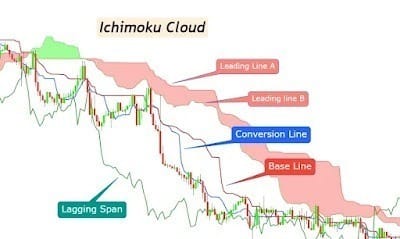
Before applying Ichimoku to a trading strategy, it is important to understand the five components that make up the system. Each component measures a different aspect of market structure and momentum.
1. Tenkan-sen — Conversion Line
The Tenkan-sen, or Conversion Line, is calculated using the midpoint between the highest high and lowest low over the previous nine periods:
Tenkan-sen = (9-period high + 9-period low) ÷ 2
Because it uses a relatively short lookback period, the Tenkan-sen responds more quickly to changes in price than the Kijun-sen. Traders often use it to assess short-term momentum.
A rising Tenkan-sen can indicate strengthening short-term bullish momentum, while a falling Tenkan-sen can indicate increasing bearish momentum. A relatively flat Tenkan-sen may suggest that short-term momentum is weakening or that the market is entering a period of consolidation.
2. Kijun-sen — Base Line
The Kijun-sen, or Base Line, uses a 26-period midpoint:
Kijun-sen = (26-period high + 26-period low) ÷ 2
Because it covers a longer period than the Tenkan-sen, the Kijun-sen is slower to react to price changes. Traders frequently use it as a reference for medium-term momentum and as a potential dynamic support or resistance level.
When price trades above the Kijun-sen, the market may have a bullish bias. When price trades below it, the bias may be bearish. However, the Kijun-sen should be interpreted within the broader Ichimoku structure rather than used as an isolated trading rule.
3. Senkou Span A — Leading Span A
Senkou Span A is calculated from the midpoint of the Tenkan-sen and Kijun-sen and then projected 26 periods forward:
Senkou Span A = (Tenkan-sen + Kijun-sen) ÷ 2
This forms one boundary of the Ichimoku Cloud, also known as the Kumo.
4. Senkou Span B — Leading Span B
Senkou Span B uses a longer 52-period calculation and is also projected 26 periods into the future:
Senkou Span B = (52-period high + 52-period low) ÷ 2
Senkou Span B forms the second boundary of the Cloud. Because it uses a longer lookback period, it generally changes more slowly than Senkou Span A.
5. Chikou Span — Lagging Span
The Chikou Span, or Lagging Span, represents the current closing price plotted 26 periods behind the current market price.
Traders use the Chikou Span as a confirmation tool. For example, a bullish market structure may receive additional confirmation when the Chikou Span is positioned above historical price action, while a bearish structure may receive confirmation when it is positioned below historical price action.
Understanding the Kumo — The Ichimoku Cloud
The space between Senkou Span A and Senkou Span B forms the Kumo, or Cloud. The Cloud is one of the most recognizable and important features of the Ichimoku system.
In general:
- Price above the Cloud: Often interpreted as a bullish market environment.
- Price below the Cloud: Often interpreted as a bearish market environment.
- Price inside the Cloud: Can indicate consolidation, uncertainty, or a transition between market conditions.
The Cloud also provides a forward-looking reference because its boundaries are projected into the future. The distance between the two spans can provide information about the relative width of the Cloud and the market structure surrounding it.
A wider Cloud may represent a more substantial area of potential support or resistance, while a narrow Cloud may indicate a less pronounced zone. Nevertheless, Cloud thickness should never be treated as a guarantee that price will reverse or remain above or below a particular level.
The Core Ichimoku Trading Signals
The most effective way to use Ichimoku is to look for agreement among several components rather than relying on one signal in isolation.
Trend Direction
The relationship between price and the Cloud provides one of the most basic Ichimoku trend filters.
When price is consistently above the Cloud, traders may interpret the broader structure as bullish. When price remains below the Cloud, the broader structure may be bearish. When price moves through the Cloud repeatedly, the market may be experiencing consolidation or a transition in trend.
The Tenkan-sen and Kijun-sen Cross
A commonly watched Ichimoku signal occurs when the faster Tenkan-sen crosses the slower Kijun-sen.
A bullish TK cross occurs when the Tenkan-sen moves above the Kijun-sen. A bearish TK cross occurs when the Tenkan-sen moves below the Kijun-sen.
The location of the crossover can provide additional context. A bullish crossover above the Cloud may be viewed as having stronger alignment with an existing bullish structure, while a bearish crossover below the Cloud may have stronger alignment with a bearish structure.
Crossovers occurring inside the Cloud can be more ambiguous because the market itself may be in a consolidation or transition phase.
The Kumo Breakout
A Kumo breakout occurs when price moves decisively through the Cloud.
A sustained move above the Cloud may suggest that bullish momentum is gaining strength, particularly if the Tenkan-sen, Kijun-sen, and Chikou Span provide supporting confirmation.
Conversely, a decisive move below the Cloud may suggest increasing bearish pressure.
However, traders should be cautious of false breakouts. A candle temporarily moving through the Cloud does not necessarily mean that a new trend has begun. Waiting for confirmation through subsequent price action and other Ichimoku components can help reduce the risk of acting on a failed breakout.
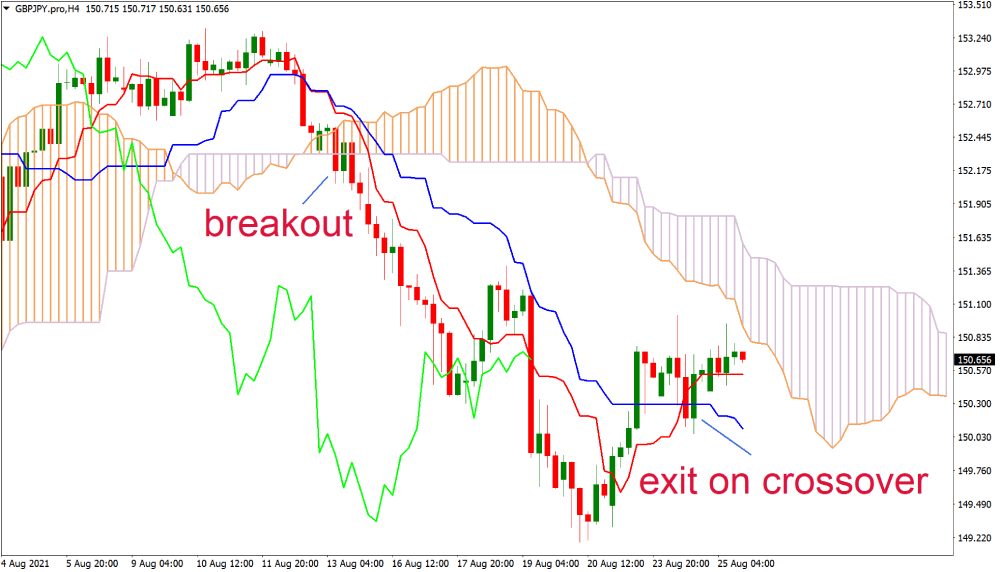
The chart above illustrates how a price breakout through the Ichimoku Cloud can signal a potential transition in market conditions. Traders should look for confirmation rather than treating a single Cloud break as a guaranteed trend reversal.
How to Interpret a Strong Ichimoku Breakout
Not all Cloud breakouts carry the same significance. A stronger breakout typically involves several forms of confirmation occurring around the same time.
For a potential bullish breakout, traders may look for price to close decisively above the Cloud while the Tenkan-sen moves above the Kijun-sen and the Chikou Span gains a supportive position relative to historical price action.
The future Cloud can also provide additional context. A bullish configuration in which Senkou Span A is above Senkou Span B may strengthen the overall bullish interpretation, although it does not guarantee that the trend will continue.
On the bearish side, traders may look for price to close below the Cloud, the Tenkan-sen to move below the Kijun-sen, and the Chikou Span to confirm weakness relative to historical price action.
These conditions do not need to occur at exactly the same moment. Instead, they can be viewed as different pieces of evidence that help traders evaluate whether a breakout has broader structural support.
Why False Breakouts Matter
False breakouts are common in financial markets. Price may move beyond the Cloud briefly before returning inside it. This can happen when market liquidity is thin, when traders react to unexpected news, or when the market lacks sufficient momentum to sustain the breakout.
One way traders attempt to reduce exposure to false signals is by waiting for a candle close beyond the Cloud rather than reacting to an intraday price move alone. Some may also wait for a retest of the Cloud before considering whether the previous resistance or support zone has changed its role.
There is no method that completely eliminates false breakouts. The purpose of confirmation is to improve the quality of the decision-making process, not to guarantee a successful trade.
Advanced Analysis 1: Identifying Divergence for Early Warnings
While many traders use the Ichimoku Cloud primarily for trend-following, its components can also provide useful information when price movement and momentum begin to lose alignment.
Divergence occurs when price makes a new high or low while a momentum-related measure fails to confirm the move. This can sometimes provide an early warning that an existing trend is losing strength.
Chikou Span and Price Structure
The Chikou Span provides a unique way of examining the relationship between current price and historical price action.
For example, suppose a currency pair such as EUR/USD continues to make higher highs while the Chikou Span struggles to establish corresponding strength relative to historical price action. This may indicate that the underlying bullish momentum deserves closer scrutiny.
This condition should not automatically be interpreted as a sell signal. Instead, it can serve as an early warning that traders should monitor the market for additional evidence of weakening momentum.
Additional confirmation could come from a bearish TK cross, a break below the Kijun-sen, a move back into the Cloud, or the development of a broader bearish price structure.
Tenkan-sen Momentum Weakening
Another potential warning occurs when price continues to make higher highs while the Tenkan-sen becomes increasingly flat or fails to keep pace with price.
This may indicate that short-term momentum is slowing. Traders can then monitor whether price begins to consolidate, retrace toward the Kijun-sen, or develop a broader reversal structure.
Divergence is best treated as a warning signal rather than an entry trigger. Markets can remain overextended for much longer than expected, and divergence alone does not establish that a reversal will occur.
For this reason, divergence analysis may also be useful for trade management. A trader already holding a position could use weakening momentum as a reason to review stop-loss placement, reduce exposure, or wait for additional confirmation rather than immediately exiting a trade.
Advanced Analysis 2: Gauging Trend Strength with the Kumo
The Cloud is not simply a visual background. Its structure can provide additional context about the quality and strength of a trend.
Characteristics of a Stronger Bullish Structure
A relatively strong bullish structure may involve several conditions occurring together:
- Price consistently remains above the Cloud.
- The Cloud is rising rather than remaining completely flat.
- Senkou Span A remains above Senkou Span B.
- The Tenkan-sen remains above the Kijun-sen.
- The Kijun-sen provides repeated areas of potential dynamic support.
- The Chikou Span confirms the broader bullish structure.
When several of these conditions occur simultaneously, the market structure may be more convincingly bullish than when only one signal is present.
Characteristics of a Weaker or Corrective Trend
A corrective bullish move may display different characteristics. Price could struggle around the Cloud, the Tenkan-sen and Kijun-sen may repeatedly cross, or the Cloud may become relatively flat and narrow.
These conditions can suggest that the market lacks a clear directional bias. Traders may therefore choose to wait for stronger confirmation rather than forcing a trade in an uncertain environment.
The Kumo Twist
A Kumo Twist occurs when Senkou Span A crosses Senkou Span B, changing the relative orientation of the two Cloud boundaries.
A bullish twist occurs when Senkou Span A moves above Senkou Span B, while a bearish twist occurs when Senkou Span A moves below Senkou Span B.
Because the Cloud is projected forward, traders sometimes monitor future twists as part of their assessment of potential changes in market structure.
A twist from a bearish configuration toward a bullish configuration may indicate that market conditions are changing, while the opposite may suggest increasing bearish pressure.
However, a Kumo Twist should not be interpreted as a guaranteed prediction of a reversal. It is better viewed as one piece of information within a broader technical framework.
Advanced Analysis 3: Identifying Potential Reversal Setups
One of the strengths of the Ichimoku system is that several components can be combined to build a structured reversal hypothesis.
Consider a hypothetical bullish reversal scenario:
- Existing Downtrend: Price has been trading below the Cloud.
- Price Re-enters the Cloud: Price moves upward into the Kumo, suggesting that the previous bearish structure may be losing momentum.
- Bullish TK Cross: The Tenkan-sen crosses above the Kijun-sen, indicating improving short-term momentum.
- Cloud Breakout: Price subsequently closes above the Cloud.
- Chikou Confirmation: The Chikou Span gains a more supportive position relative to historical price action.
- Cloud Structure Improves: The future Cloud develops a more bullish configuration.
When multiple conditions align, the setup can provide stronger confirmation than any individual signal by itself.
The same framework can be applied in reverse when evaluating potential bearish reversals.
Even so, traders should remember that confirmation often comes after part of a move has already occurred. The objective is not to predict every market turning point but to develop a repeatable process for evaluating whether the evidence supports a trade.
Using Ichimoku with Price Action and Fundamental Analysis
Technical indicators become more useful when they are interpreted within the broader market environment.
A trader may use the Ichimoku Cloud to establish the broader market structure and then use price action to refine potential entries. For example, a bullish market above the Cloud may become more interesting if price pulls back toward the Kijun-sen and forms a recognizable bullish price-action pattern such as a pin bar or bullish engulfing candle.
Similarly, a bearish market below the Cloud may receive additional confirmation if price retests the Kijun-sen or Cloud boundary and forms a bearish rejection pattern.
Traders can also combine Ichimoku analysis with awareness of major economic events such as central-bank interest-rate decisions, inflation reports, employment data, gross domestic product releases, and major geopolitical developments.
This is particularly important in forex because currency markets can experience substantial volatility around high-impact economic announcements.
A technically bullish setup, for example, can fail quickly if an unexpected central-bank announcement causes a sharp change in interest-rate expectations.
The combination of market structure, price action, fundamental context, and disciplined risk management can therefore provide a more comprehensive approach than relying exclusively on a technical indicator.
Risk Management When Trading Ichimoku Setups
No Ichimoku configuration eliminates trading risk. Even apparently strong setups can fail because markets are influenced by unexpected economic data, changes in monetary policy, geopolitical developments, liquidity conditions, and sudden shifts in investor sentiment.
Traders should therefore consider the following risk-management principles:
- Use appropriate position sizing: Position size should reflect the amount of capital a trader is willing and able to risk.
- Define invalidation before entering: Traders should know what market condition would prove their trade idea wrong.
- Avoid excessive leverage: High leverage can magnify both gains and losses.
- Consider market volatility: Stop-loss placement should account for the normal price fluctuations of the currency pair and timeframe being traded.
- Monitor economic events: High-impact news can create sharp movements that invalidate technical setups.
- Avoid overconfidence: Multiple confirming signals do not guarantee a profitable outcome.
Technical confirmation can improve a trading process, but it cannot remove uncertainty from financial markets.
Common Mistakes When Using the Ichimoku Cloud
1. Trading Every TK Cross
Not every Tenkan-sen/Kijun-sen crossover represents a high-quality trading opportunity. The market’s position relative to the Cloud and the broader trend should be considered.
2. Treating the Cloud as an Exact Wall
The Cloud represents a zone rather than an infallible barrier. Price can move through it, temporarily reject it, or fluctuate inside it.
3. Ignoring the Broader Market Context
A technically attractive setup can fail when a major economic announcement causes a sudden repricing of a currency.
4. Using Too Many Confirmations
More indicators do not automatically produce better decisions. The goal should be a clear and repeatable trading framework rather than an unnecessarily complicated collection of signals.
5. Ignoring Risk Management
Even a technically strong setup can result in a loss. Position sizing and trade risk should therefore remain central to the trading process.
How to Build a Simple Ichimoku Trading Checklist
One practical way to avoid impulsive trading decisions is to create a checklist before entering a position. The purpose of the checklist is not to guarantee a profitable trade, but to ensure that the major elements of the market structure have been considered.
Before considering an Ichimoku-based trade, a trader could ask the following questions:
- Is price above, below, or inside the Ichimoku Cloud?
- What direction is the broader market trend showing?
- Is the Tenkan-sen above or below the Kijun-sen?
- Has a recent bullish or bearish TK cross occurred?
- Where is the Chikou Span relative to historical price action?
- Is the Cloud rising, falling, flat, thick, or narrow?
- Has price broken through the Cloud decisively or only temporarily?
- Is there confirmation from price action?
- Are major economic announcements approaching?
- What market condition would invalidate the trade idea?
- Is the potential reward appropriate relative to the amount being risked?
This type of checklist can help transform Ichimoku from a collection of lines into a structured decision-making framework. It can also help traders remain consistent instead of entering positions based solely on emotion or a single technical signal.
Choosing the Right Timeframe for Ichimoku
The Ichimoku Cloud can be applied across different chart timeframes, but the appropriate timeframe depends on the trader’s strategy, objectives, and tolerance for market noise.
Higher timeframes such as the 4-hour and daily charts can provide a broader view of market structure and may reduce some of the short-term noise found on lower timeframes. Shorter timeframes can produce more trading opportunities, but they may also generate more false signals and require faster decision-making.
Rather than assuming that one timeframe is universally superior, traders should test the Ichimoku system across different market conditions and determine which timeframe fits their trading plan.
A multi-timeframe approach can also be useful. For example, a trader might use a higher timeframe to identify the broader trend and a lower timeframe to examine potential entry conditions. However, adding timeframes should make the analysis clearer rather than unnecessarily complicated.
Conclusion: A Balanced Perspective on Ichimoku
The Ichimoku Cloud is one of the more comprehensive technical analysis systems available to forex traders. Its combination of trend direction, momentum, dynamic support and resistance, and forward-projected Cloud structure allows traders to analyze several dimensions of the market within a single framework.
Its greatest advantage is not that it predicts the future, but that it can help organize market information into a structured analytical process.
However, Ichimoku should not be treated as a standalone trading system that produces guaranteed results. Markets can behave unpredictably, particularly during major economic announcements and periods of extreme volatility.
A more disciplined approach is to use Ichimoku as a framework for identifying market conditions, then seek confirmation through price action, broader market structure, fundamental developments, and appropriate risk management.
Ultimately, mastering the Ichimoku Cloud requires more than memorizing its five components. It requires understanding how those components interact and developing the discipline to wait for conditions that fit a clearly defined trading plan.
Continue Learning Forex with SkyPress
If you want to build a stronger foundation in forex trading, technical analysis, risk management, and market structure, explore the SkyPress Forex Academy.
You can also explore more currency-market education, analysis, and related articles through the SkyPress Forex Markets category.
Frequently Asked Questions About the Ichimoku Cloud
What is the Ichimoku Cloud?
The Ichimoku Cloud, or Ichimoku Kinko Hyo, is a technical analysis system that combines multiple calculations to help traders assess trend direction, momentum, potential support and resistance, and market structure.
What does price above the Ichimoku Cloud mean?
Price trading above the Cloud is generally interpreted as a bullish market environment. However, traders should consider the other Ichimoku components and broader price action before making a trading decision.
What does price below the Ichimoku Cloud mean?
Price below the Cloud generally indicates a bearish market environment. The signal can become more meaningful when other components of the Ichimoku system support the bearish structure.
What does price inside the Ichimoku Cloud mean?
Price trading inside the Cloud can indicate consolidation, uncertainty, or a transition between bullish and bearish market conditions. Traders may prefer to wait for a clearer breakout or additional confirmation before taking a directional position.
What is a TK Cross?
A TK Cross occurs when the Tenkan-sen crosses the Kijun-sen. A cross in which the Tenkan-sen moves above the Kijun-sen is generally considered bullish, while a cross below the Kijun-sen is generally considered bearish.
What is a Kumo breakout?
A Kumo breakout occurs when price moves through the Ichimoku Cloud. A sustained move above the Cloud may indicate improving bullish conditions, while a sustained move below it may indicate increasing bearish pressure. Confirmation is important because false breakouts can occur.
What is the Kumo Twist?
A Kumo Twist occurs when Senkou Span A crosses Senkou Span B, changing the orientation of the future Cloud. It can provide information about changing market structure but should not be treated as a guaranteed reversal signal.
Is the Ichimoku Cloud good for forex trading?
Ichimoku can be useful for forex analysis because it provides information about trend, momentum, and potential support and resistance within one framework. Its usefulness depends on the trader’s strategy, timeframe, market conditions, and risk-management approach.
What timeframe is best for the Ichimoku Cloud?
There is no universally best timeframe. Many traders use Ichimoku on higher timeframes such as the 4-hour and daily charts because these can provide a broader view of market structure. Other traders adapt the system to shorter timeframes. The appropriate timeframe depends on the trader’s strategy and objectives.
Can the Ichimoku Cloud predict forex reversals?
No. Ichimoku can help identify conditions that may accompany a reversal, but it cannot reliably predict future price movements. Reversal setups should be evaluated alongside price action, market structure, fundamental conditions, and risk management.
Can beginners use the Ichimoku Cloud?
Yes. Beginners can learn Ichimoku, but it is important to understand each component before attempting to trade the complete system. Starting with price versus the Cloud and then learning the Tenkan-sen, Kijun-sen, Senkou spans, and Chikou Span can make the learning process easier.
Is Ichimoku better than other forex indicators?
There is no universally superior technical indicator. Ichimoku is distinctive because it combines several forms of market information into one system, but different traders may prefer different tools depending on their strategies, timeframes, and trading objectives.
Does the Ichimoku Cloud work in all market conditions?
No indicator works equally well in every market environment. Ichimoku can be particularly useful when a market has a clear directional trend, while signals may become less reliable or more difficult to interpret during choppy or sideways conditions.
Can Ichimoku be used with other indicators?
Yes. Some traders combine Ichimoku with other forms of technical analysis, including price action, support and resistance, volume-based analysis, or momentum tools. However, adding more indicators does not automatically improve a strategy. The goal should be to create a clear and consistent analytical process.
Does Ichimoku guarantee profitable trades?
No. No technical indicator or trading strategy can guarantee profits. Ichimoku signals can fail, especially during volatile, sideways, or news-driven market conditions. Proper risk management is therefore essential.
SkyPress Disclaimer
Disclaimer: This article is provided by SkyPress for educational and informational purposes only and should not be considered financial, investment, trading, legal, tax, or other professional advice.
Forex trading involves substantial risk, including the potential loss of capital. The technical analysis concepts, examples, strategies, and market observations discussed in this article are intended for educational purposes and should not be interpreted as recommendations to buy, sell, or hold any currency pair or financial instrument.
No trading strategy, technical indicator, or analytical method can guarantee profits or eliminate the possibility of losses. Ichimoku Cloud signals may produce false, delayed, or conflicting indications, and market conditions can change rapidly, particularly around major economic announcements and unexpected geopolitical events.
Before making any financial or trading decision, conduct your own research, consider your financial circumstances and risk tolerance, and seek advice from a qualified financial professional where appropriate.
SkyPress does not guarantee the accuracy, completeness, or future performance of any trading strategy, technical analysis, market commentary, or educational material published on this website.
Past market performance is not necessarily indicative of future results. Any examples used in this article are illustrative and should not be interpreted as promises or expectations of future trading outcomes.
By using information published on SkyPress, readers acknowledge that they are responsible for their own financial and trading decisions.