
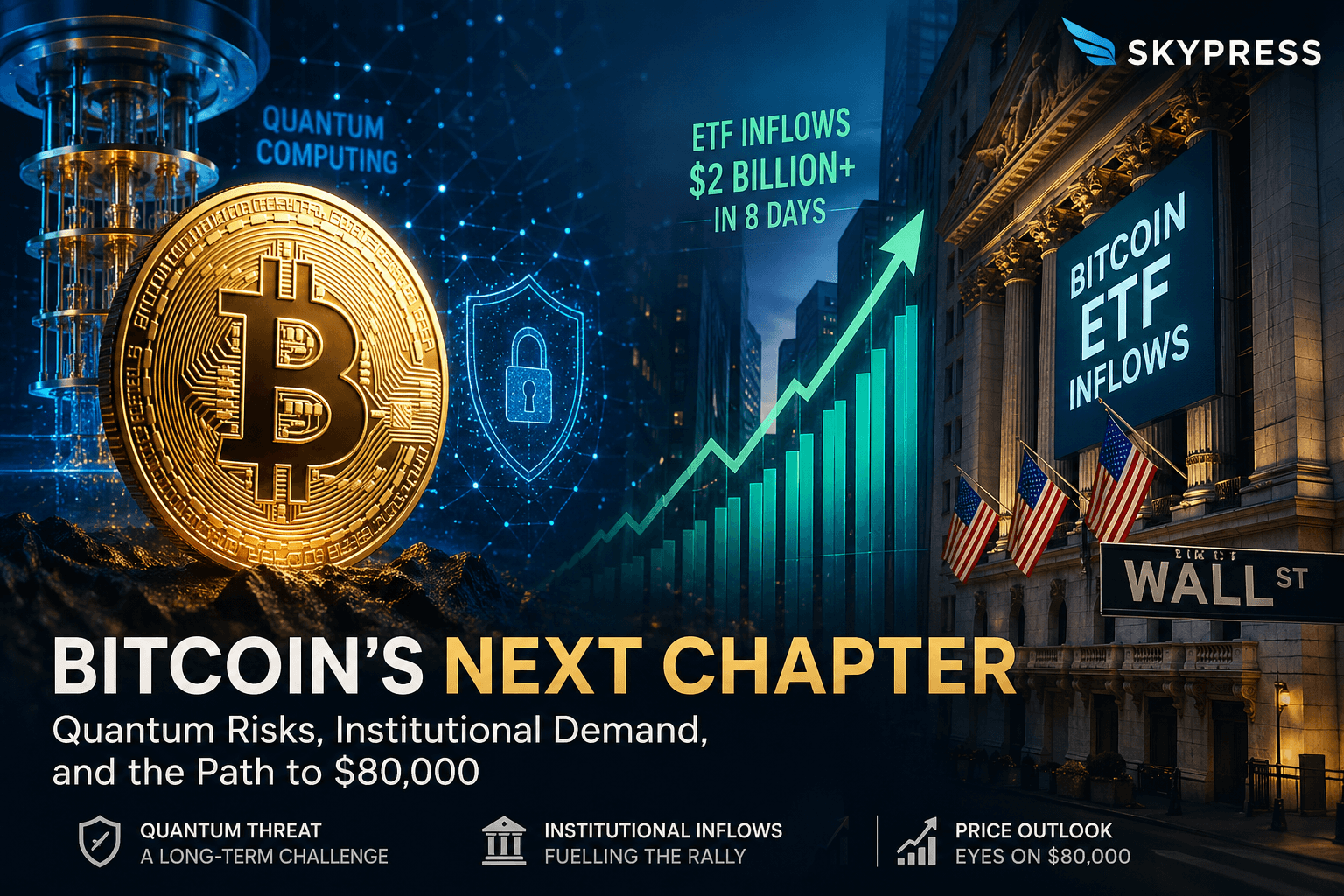
Bitcoin’s Quantum Threat Meets Wall Street Demand: ETF Inflows Push BTC Toward $80,000


Bitcoin’s Quantum Challenge, ETF Inflows, and the Road to $80,000
Bitcoin is entering one of the most fascinating phases in its history. While institutional demand continues to accelerate through record-breaking ETF inflows, a long-term technological challenge is beginning to dominate discussions across the cryptocurrency industry: quantum computing.
On one hand, Bitcoin is benefiting from unprecedented institutional accumulation, tightening supply, and growing investor confidence. On the other, advances in quantum computing are forcing developers, investors, and security experts to confront a future where traditional cryptography may eventually become vulnerable.
This dual narrative—immediate bullish momentum combined with long-term security considerations—is shaping Bitcoin’s market outlook in 2026 and beyond.
The Quantum Computing Threat: A Future Security Challenge
Recent breakthroughs in quantum computing have reignited debate around Bitcoin’s long-term security. Contrary to popular misconception, quantum computers would not destroy the Bitcoin blockchain itself. The network’s mining process and decentralized ledger architecture remain highly resilient.
The real concern lies in wallet security.
Bitcoin ownership relies on elliptic curve cryptography—a mathematical system designed to make deriving private keys from public keys computationally impossible using classical computers. Quantum algorithms, particularly Shor’s Algorithm, could theoretically reverse this protection once sufficiently powerful hardware becomes available.
That would place exposed wallet addresses at risk.
Approximately 6.9 million BTC—nearly one-third of all Bitcoin ever mined—currently reside in addresses whose public keys are already visible on-chain.
This includes:
- Satoshi Nakamoto’s estimated 1 million BTC.
- Early legacy wallet formats.
- Coins previously spent from.
- Many addresses used after the Taproot upgrade.
Importantly, quantum computers are nowhere near capable of breaking Bitcoin today. However, the timeline has shortened considerably, prompting urgent discussions among developers and institutional custodians.
Bitcoin’s Governance Dilemma
Unlike Ethereum, which has formal governance structures and dedicated post-quantum research teams, Bitcoin operates without centralized leadership. This decentralization is one of its greatest strengths—but also a major obstacle.
Implementing a network-wide migration to quantum-resistant cryptography would require broad consensus across miners, developers, exchanges, custodians, and millions of users.
Proposed solutions such as quantum-safe address formats and emergency detection mechanisms remain under active discussion, but no definitive roadmap has yet emerged.
The race, therefore, is not against current quantum machines—but against complacency.
ETF Inflows Reach $2 Billion in Eight Trading Days
While quantum concerns remain a long-term issue, the present market story is overwhelmingly bullish.
U.S. spot Bitcoin ETFs have recorded one of their strongest accumulation streaks since launch. Over eight consecutive trading sessions ending April 24, 2026, these funds attracted more than $2 billion in net inflows.
On April 23 alone, ETFs added approximately $223 million in fresh capital.
Institutional Demand Remains Relentless
BlackRock’s iShares Bitcoin Trust (IBIT) continues to dominate flows, while ARK 21Shares and other major issuers have also seen substantial participation.
This pattern suggests:
- Growing institutional conviction.
- Strategic long-term allocation.
- Reduced circulating supply.
- Enhanced market stability.
Unlike speculative retail surges, ETF inflows represent structural demand. These vehicles continuously absorb Bitcoin from the open market, reducing available supply and strengthening price support.
Total cumulative net inflows into U.S. spot Bitcoin ETFs have now surpassed $58.5 billion.
This milestone underscores Bitcoin’s accelerating transition from a speculative asset to a recognized institutional portfolio component.
Bitcoin Price Outlook: Momentum Builds Above $77,000
Bitcoin is currently trading near multi-month highs between $77,000 and $78,000, holding firm after a powerful breakout above previous resistance levels.
Market sentiment has shifted dramatically over the past two weeks. Fear has given way to optimism, and optimism is quickly evolving into fear of missing out (FOMO).
Key Bullish Drivers
- Record ETF accumulation.
- Supply tightening across exchanges.
- Rising institutional adoption.
- Strong technical breakout above February highs.
- Improving macro risk appetite.
Analysts are closely watching the psychologically significant $80,000 level. A decisive breakout could trigger another wave of momentum-driven buying.
However, short-term volatility should be expected as early investors and short-term holders realize profits.
Market Risks Investors Should Monitor
Even amid strong bullish momentum, several risks remain on the horizon.
- Geopolitical tensions, particularly involving U.S.-Iran relations.
- Macroeconomic uncertainty surrounding inflation and interest rates.
- Short-term profit-taking from leveraged traders.
- Regulatory developments across major jurisdictions.
- Long-term cryptographic security evolution.
These factors could introduce temporary volatility, but they have not materially altered Bitcoin’s broader bullish structure.
The Bigger Picture: Bitcoin Matures
Bitcoin today stands at the intersection of institutional finance, technological innovation, and monetary transformation.
The same network that once served niche enthusiasts is now attracting sovereign wealth funds, pension managers, and multinational corporations.
At the same time, emerging technologies like quantum computing are forcing the ecosystem to prepare for future generations of security.
This is not a sign of weakness—it is a hallmark of maturity.
Bitcoin’s greatest challenge may ultimately become another catalyst for innovation.
If history is any guide, the Bitcoin network has repeatedly demonstrated an extraordinary capacity to adapt, evolve, and overcome existential threats.
Investment Outlook
For investors, the current environment presents a compelling combination of near-term momentum and long-term strategic significance.
Institutional inflows continue to validate Bitcoin’s role as a scarce digital asset, while its evolving technological challenges ensure that development remains active and robust.
The path toward $80,000 appears increasingly plausible, though volatility remains part of Bitcoin’s DNA.
Long-term investors should focus less on daily price fluctuations and more on the structural forces reshaping the asset class.
Those forces—scarcity, adoption, institutionalization, and innovation—remain firmly intact.
Disclaimer
This publication is for informational and educational purposes only and should not be construed as financial, investment, legal, or tax advice. Cryptocurrency investments involve substantial risk, including the possible loss of principal. Past performance does not guarantee future results. Readers should conduct independent research and consult a licensed financial advisor before making investment decisions. SkyPress and its contributors accept no liability for any losses arising from reliance on this material.