
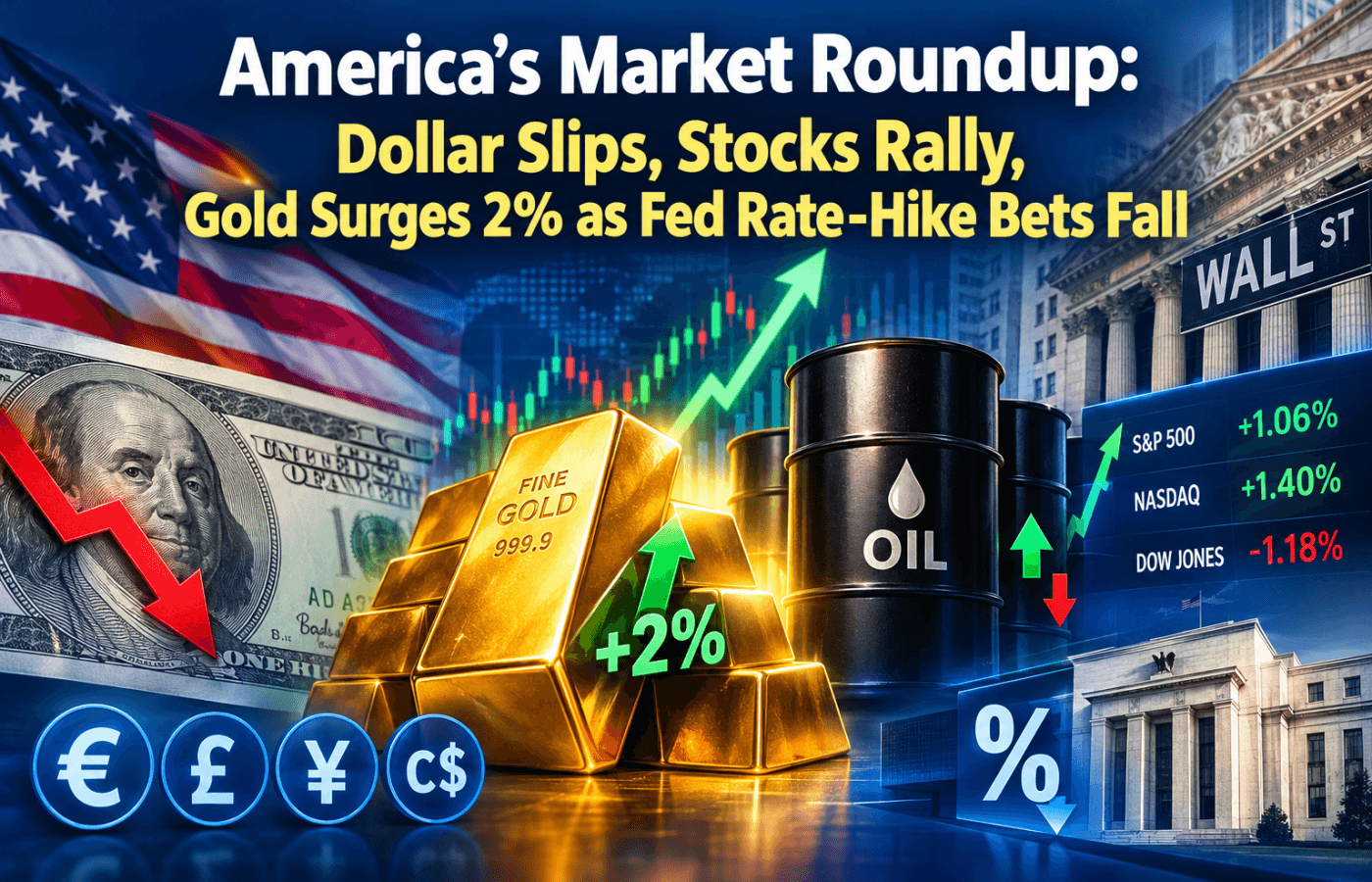
America’s Market Roundup: Dollar Slips, Stocks Rally, Gold Surges 2% as Fed Rate-Hike Bets Fall

Forex Market Outlook
EUR/USD: Euro Gains as Dollar Weakens
The EUR/USD pair edged higher on Thursday as the U.S. dollar came under pressure following Christopher Waller’s comments on Federal Reserve policy.
The prospect of the Federal Reserve maintaining interest rates rather than delivering another increase reduced some of the recent support for the dollar. However, the euro’s upside remained relatively measured as traders continued to monitor economic data and the broader interest-rate differential between the eurozone and the United States.
U.S. economic data remained broadly resilient, with service-sector activity accelerating and jobless claims staying relatively low. At the same time, elevated services input prices could complicate the Federal Reserve’s policy outlook if inflation proves persistent.
From a technical perspective, immediate resistance for EUR/USD is seen around 1.1597, near the 20-day simple moving average. A sustained break above this level could open the way toward 1.1625, corresponding to the 38.2% Fibonacci retracement level.
On the downside, initial support is located around 1.1565. A break below this level could expose the pair to further losses toward 1.1502, near the 61.8% Fibonacci retracement level.
EUR/USD bias: Neutral to mildly bullish while the pair holds above near-term support, although U.S. employment data could quickly alter the outlook.
GBP/USD: Sterling Supported by Dollar Weakness
GBP/USD also moved higher as the dollar weakened following the Federal Reserve commentary.
Sterling received additional support from the continued expansion of the United Kingdom’s services sector. The final S&P Global UK Services PMI increased to 52.5 in August from 52.1 in July, marking the strongest growth since April.
The improvement in business confidence also provided a constructive backdrop for the pound. However, traders remained cautious ahead of the U.S. employment report, which was expected to become the next major catalyst for the pair.
Market forecasts pointed to an increase of approximately 56,000 U.S. jobs, following a surprise decline of 23,000 jobs in July, while the unemployment rate was expected to remain at 4.1%.
Technically, immediate resistance for GBP/USD is located around 1.3548. A break above this level could strengthen the bullish momentum toward 1.3629, around the 38.2% Fibonacci retracement level.
On the downside, support is seen near 1.3462. A sustained break below this level could expose the pair to approximately 1.3390, near the lower Bollinger Band.
GBP/USD bias: Mildly bullish above 1.3462, but traders should remain alert to U.S. labour-market data.
USD/CAD: Canadian Dollar Strengthens
The USD/CAD pair moved lower as the Canadian dollar strengthened against its U.S. counterpart. The loonie benefited from a weaker U.S. dollar and support from elevated commodity prices.
Canada reported a trade surplus of approximately C$769 million in July, significantly below the C$4.2 billion surplus recorded in June and also below the C$3.2 billion market forecast.
Canadian imports increased to C$75.37 billion, while exports declined to C$76.14 billion.
The Bank of Canada recently kept interest rates unchanged, while Governor Tiff Macklem indicated that policymakers remained prepared to raise rates again if inflation stayed elevated. This keeps the Canadian dollar sensitive to both domestic economic data and movements in commodity markets.
Immediate resistance for USD/CAD is seen around 1.3863. A break above this level could open the way toward 1.3889.
On the downside, support is located near 1.3780. A break below this level could expose the pair to approximately 1.3711.
USD/CAD bias: Bearish below 1.3863, with commodity prices and U.S. dollar direction remaining important drivers.
USD/JPY: Yen Strengthens on BOJ Expectations
The USD/JPY pair declined as the Japanese yen strengthened amid growing expectations that the Bank of Japan could raise interest rates later in September.
Bank of Japan Governor Kazuo Ueda indicated that policymakers would consider a September rate increase, particularly as inflation risks remain an important factor in the central bank’s decision-making process.
Japanese authorities also continued to monitor currency-market developments. Japan’s top currency diplomat Atsushi Mimura said officials remained vigilant regarding recent yen movements.
Markets are also considering the possibility of another rate increase in October, although this is currently viewed as less likely than a September move.
Technically, immediate resistance for USD/JPY is located near 159.23. A break above this level could expose the pair to the recent daily high around 160.38.
On the downside, initial support is found around 155.39. A break below this level could bring the psychologically important 155.00 level into focus.
USD/JPY bias: Bearish while the yen remains supported by expectations of tighter Bank of Japan policy.
Equities Recap: Wall Street Advances
European equities recovered on Thursday, ending a three-session losing streak as pressure in global bond markets eased. Investors continued to assess economic data for clues about the future path of interest rates.
The FTSE 100 gained approximately 0.70%, Germany’s DAX advanced 0.63%, while France’s CAC 40 rose around 0.07%.
U.S. equities performed strongly as investors reduced expectations for another Federal Reserve rate increase. The possibility of less restrictive monetary policy supported demand for risk assets.
- Dow Jones Industrial Average: -1.18%
- S&P 500: +1.06%
- Nasdaq Composite: +1.40%
The mixed performance within the major U.S. indexes highlights the different ways investors are responding to changes in interest-rate expectations and sector-specific positioning.
The strong performance of the Nasdaq was particularly notable because technology and growth stocks are often sensitive to changes in bond yields and expectations for future monetary policy.
Forex Market Outlook
EUR/USD: Euro Gains as Dollar Weakens
The EUR/USD pair edged higher on Thursday as the U.S. dollar came under pressure following Christopher Waller’s comments on Federal Reserve policy.
The prospect of the Federal Reserve maintaining interest rates rather than delivering another increase reduced some of the recent support for the dollar. However, the euro’s upside remained relatively measured as traders continued to monitor economic data and the broader interest-rate differential between the eurozone and the United States.
U.S. economic data remained broadly resilient, with service-sector activity accelerating and jobless claims staying relatively low. At the same time, elevated services input prices could complicate the Federal Reserve’s policy outlook if inflation proves persistent.
From a technical perspective, immediate resistance for EUR/USD is seen around 1.1597, near the 20-day simple moving average. A sustained break above this level could open the way toward 1.1625, corresponding to the 38.2% Fibonacci retracement level.
On the downside, initial support is located around 1.1565. A break below this level could expose the pair to further losses toward 1.1502, near the 61.8% Fibonacci retracement level.
EUR/USD bias: Neutral to mildly bullish while the pair holds above near-term support, although U.S. employment data could quickly alter the outlook.
GBP/USD: Sterling Supported by Dollar Weakness
GBP/USD also moved higher as the dollar weakened following the Federal Reserve commentary.
Sterling received additional support from the continued expansion of the United Kingdom’s services sector. The final S&P Global UK Services PMI increased to 52.5 in August from 52.1 in July, marking the strongest growth since April.
The improvement in business confidence also provided a constructive backdrop for the pound. However, traders remained cautious ahead of the U.S. employment report, which was expected to become the next major catalyst for the pair.
Market forecasts pointed to an increase of approximately 56,000 U.S. jobs, following a surprise decline of 23,000 jobs in July, while the unemployment rate was expected to remain at 4.1%.
Technically, immediate resistance for GBP/USD is located around 1.3548. A break above this level could strengthen the bullish momentum toward 1.3629, around the 38.2% Fibonacci retracement level.
On the downside, support is seen near 1.3462. A sustained break below this level could expose the pair to approximately 1.3390, near the lower Bollinger Band.
GBP/USD bias: Mildly bullish above 1.3462, but traders should remain alert to U.S. labour-market data.
USD/CAD: Canadian Dollar Strengthens
The USD/CAD pair moved lower as the Canadian dollar strengthened against its U.S. counterpart. The loonie benefited from a weaker U.S. dollar and support from elevated commodity prices.
Canada reported a trade surplus of approximately C$769 million in July, significantly below the C$4.2 billion surplus recorded in June and also below the C$3.2 billion market forecast.
Canadian imports increased to C$75.37 billion, while exports declined to C$76.14 billion.
The Bank of Canada recently kept interest rates unchanged, while Governor Tiff Macklem indicated that policymakers remained prepared to raise rates again if inflation stayed elevated. This keeps the Canadian dollar sensitive to both domestic economic data and movements in commodity markets.
Immediate resistance for USD/CAD is seen around 1.3863. A break above this level could open the way toward 1.3889.
On the downside, support is located near 1.3780. A break below this level could expose the pair to approximately 1.3711.
USD/CAD bias: Bearish below 1.3863, with commodity prices and U.S. dollar direction remaining important drivers.
USD/JPY: Yen Strengthens on BOJ Expectations
The USD/JPY pair declined as the Japanese yen strengthened amid growing expectations that the Bank of Japan could raise interest rates later in September.
Bank of Japan Governor Kazuo Ueda indicated that policymakers would consider a September rate increase, particularly as inflation risks remain an important factor in the central bank’s decision-making process.
Japanese authorities also continued to monitor currency-market developments. Japan’s top currency diplomat Atsushi Mimura said officials remained vigilant regarding recent yen movements.
Markets are also considering the possibility of another rate increase in October, although this is currently viewed as less likely than a September move.
Technically, immediate resistance for USD/JPY is located near 159.23. A break above this level could expose the pair to the recent daily high around 160.38.
On the downside, initial support is found around 155.39. A break below this level could bring the psychologically important 155.00 level into focus.
USD/JPY bias: Bearish while the yen remains supported by expectations of tighter Bank of Japan policy.
Equities Recap: Wall Street Advances
European equities recovered on Thursday, ending a three-session losing streak as pressure in global bond markets eased. Investors continued to assess economic data for clues about the future path of interest rates.
The FTSE 100 gained approximately 0.70%, Germany’s DAX advanced 0.63%, while France’s CAC 40 rose around 0.07%.
U.S. equities performed strongly as investors reduced expectations for another Federal Reserve rate increase. The possibility of less restrictive monetary policy supported demand for risk assets.
- Dow Jones Industrial Average: -1.18%
- S&P 500: +1.06%
- Nasdaq Composite: +1.40%
The mixed performance within the major U.S. indexes highlights the different ways investors are responding to changes in interest-rate expectations and sector-specific positioning.
The strong performance of the Nasdaq was particularly notable because technology and growth stocks are often sensitive to changes in bond yields and expectations for future monetary policy.
Gold Prices Jump More Than 2%
Gold was one of the biggest beneficiaries of Thursday’s shift in Federal Reserve expectations. Spot gold rose approximately 2.3% to around $4,488.54 per ounce, after reaching its highest level since August 28 during the session.
U.S. gold futures settled approximately 2.8% higher at $4,539.90.
The sharp move higher came after Federal Reserve Governor Christopher Waller indicated that he could support leaving interest rates unchanged if incoming data confirms that inflationary pressures are easing.
Gold typically benefits when expectations for higher interest rates decline because lower yields can reduce the opportunity cost of holding a non-yielding asset such as gold.
The precious metal is also supported by broader investor demand for safe-haven assets. However, the sustainability of the rally will depend heavily on upcoming U.S. inflation, employment and Federal Reserve policy expectations.
For investors following precious metals, our Commodities section provides additional market coverage and analysis.
Oil Prices Remain Volatile
Oil prices finished Thursday’s session mixed as traders balanced geopolitical supply risks against developments that could eventually reduce concerns about disruptions in the Middle East.
Brent crude futures settled around $95.52 per barrel, down approximately 0.12%, while U.S. West Texas Intermediate crude futures rose approximately 0.32% to $91.30 per barrel.
Both benchmarks reached six-week highs earlier in the session.
Concerns over potential disruption to Middle Eastern oil supplies provided support to prices following U.S. strikes on Iran and renewed Israeli threats against Tehran. However, comments from Russian President Vladimir Putin indicating openness to peace negotiations helped limit some of the upside.
Oil markets therefore remain highly sensitive to geopolitical headlines. Any escalation that threatens production, transportation routes or exports from major producing countries could create additional upward pressure on crude prices.
Conversely, progress toward negotiations or a reduction in geopolitical tensions could remove some of the risk premium currently embedded in oil prices.
Japan Economic Data in Focus
Asian markets will turn their attention to upcoming Japanese economic data, particularly household spending and leading economic indicators.
Japanese household spending is forecast to increase by 2.6% month-on-month in July, following a sharp decline of 6.4% previously. On a year-on-year basis, household spending is forecast to decline by 1.6%, compared with a previous decline of 3.3%.
Japan will also release its coincident and leading economic indicators. The coincident indicator previously recorded a monthly increase of 0.6%, while the leading index stood at 116.5.
These figures could provide additional clues about the strength of domestic Japanese demand and the economic environment facing the Bank of Japan.
What Traders Should Watch Next
The next major focus for financial markets is the U.S. employment report. Labour-market data has become particularly important because the Federal Reserve is attempting to balance inflation risks against signs of potential weakness in employment.
A stronger-than-expected employment report could revive expectations for tighter U.S. monetary policy, potentially supporting the dollar and putting pressure on gold. Conversely, weak employment data could reinforce expectations that the Federal Reserve will maintain or eventually ease its policy stance.
Forex traders should therefore pay close attention to the interaction between employment, inflation and Federal Reserve communication rather than relying on any single economic indicator.
Market Outlook
The latest session demonstrated how quickly financial markets can respond to changes in central-bank expectations. Waller’s comments were enough to weaken the dollar, lift U.S. equities and push gold sharply higher despite several strong U.S. economic indicators.
For the Forex market, the immediate direction of the U.S. dollar will likely depend on whether upcoming economic data confirms or challenges the more patient policy stance suggested by Waller.
EUR/USD and GBP/USD could retain upside momentum if the dollar continues to weaken, while USD/JPY remains vulnerable if expectations for further Bank of Japan tightening strengthen. USD/CAD will continue to be influenced by both monetary-policy expectations and movements in commodity prices.
Meanwhile, gold remains firmly in focus as investors reassess the path of U.S. interest rates, while oil markets continue to price geopolitical risks alongside supply and demand fundamentals.
Key Takeaways for Forex Traders
- The U.S. dollar weakened after Christopher Waller signalled a willingness to keep Federal Reserve rates unchanged if inflation continues to cool.
- Expectations for a September Fed rate hike declined following Waller’s comments.
- U.S. economic activity remained resilient, particularly in the services sector.
- Elevated services-sector prices remain a potential obstacle to a rapid shift toward easier monetary policy.
- EUR/USD and GBP/USD benefited from the softer dollar.
- The Japanese yen strengthened as markets priced in a greater possibility of a Bank of Japan rate increase.
- Gold surged more than 2% as expectations for higher U.S. rates declined.
- Oil prices remained volatile because of competing geopolitical and peace-negotiation developments.
- The upcoming U.S. employment report could become the next major catalyst for currencies, equities and gold.
SkyPress Market Perspective
The current market environment remains highly sensitive to central-bank communication. Traders should expect volatility to increase around major U.S. economic releases, particularly employment and inflation data.
Rather than interpreting one economic report in isolation, market participants should consider the broader trend in inflation, employment, economic growth and central-bank policy expectations.
For ongoing market coverage, follow SkyPress for updates across Forex Markets, Commodities, Investing and Latest News & Global Updates.
Disclaimer
Disclaimer: This SkyPress market report is provided for informational and educational purposes only and should not be considered financial, investment or trading advice. Financial markets can be highly volatile, and past performance does not guarantee future results. The technical levels, forecasts and market views presented in this article are subject to change as new economic data and market developments emerge. Readers should conduct their own research and consider their financial circumstances and risk tolerance before making any investment or trading decisions. SkyPress does not guarantee the accuracy, completeness or future performance of any market forecast or analysis presented in this report.