
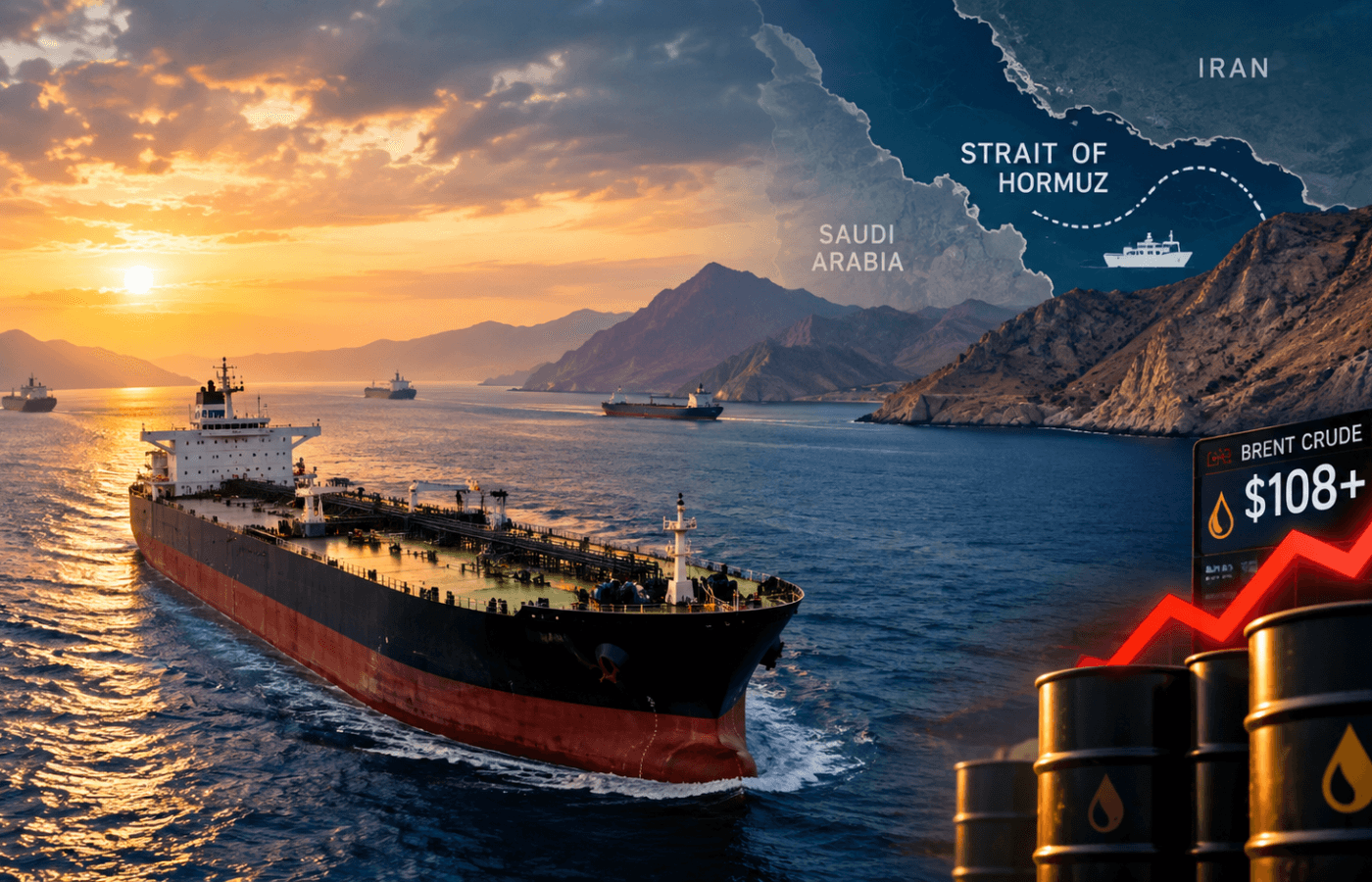
Oil Prices Surge as Middle East Disruptions Raise Fears of a Global Supply Shock

Brent Crude Oil Surges Above $108 as Middle East Supply Disruptions Intensify
Oil markets face renewed supply concerns as tensions around the Strait of Hormuz, Saudi Arabia’s export infrastructure and the Bab el-Mandeb Strait intensify.
Brent crude oil prices have surged above $108 a barrel as escalating Middle East tensions raise fresh concerns about the security of global oil supplies. The latest move higher comes after renewed attacks on Saudi energy infrastructure, the temporary shutdown of a key Saudi pipeline and continued disruption risks around two of the world’s most important maritime energy corridors.
The latest developments have transformed what was already a major geopolitical risk into a broader global energy-supply concern. Investors, governments and energy consumers are now watching closely to determine whether the disruptions remain temporary or develop into a prolonged shortage of crude oil.
- Brent crude has moved above $108 a barrel amid renewed Middle East supply concerns.
- The temporary shutdown of Saudi Arabia’s East-West pipeline has removed an important alternative route around the Strait of Hormuz.
- Ongoing tensions around the Strait of Hormuz continue to threaten a major global oil-shipping corridor.
- Developments around the Bab el-Mandeb Strait are adding another layer of risk to Middle East energy transportation.
- Goldman Sachs has warned that Brent could potentially move toward or above $120 if supply disruptions persist.
- Higher oil prices could feed into transportation costs, inflation, currencies, interest-rate expectations and global economic growth.
Brent Crude Climbs Above $108
Brent crude, the international benchmark for oil prices, has moved sharply higher as traders reassess the potential impact of disruptions across the Middle East.
Reuters reported that Brent futures rose to around $108.04 per barrel, while U.S. West Texas Intermediate crude climbed above $103. The move followed renewed attacks on Saudi energy infrastructure and heightened concerns over shipping through the Strait of Hormuz.
The latest surge comes after Brent had already broken above the $100 threshold earlier in September. That means the market is no longer responding to an isolated geopolitical headline. Instead, traders are increasingly pricing the possibility that a combination of shipping restrictions and infrastructure damage could create a sustained reduction in available crude supplies.
That distinction is important.
Oil markets can absorb a temporary disruption relatively quickly if alternative supplies are available. A prolonged disruption affecting multiple export routes is considerably more difficult to manage.
Why the Strait of Hormuz Remains Central to the Oil Market
The Strait of Hormuz is one of the most strategically important waterways in the global energy system.
Oil-producing countries in the Persian Gulf depend heavily on maritime routes to move crude and petroleum products toward international markets. Any sustained restriction through the strait therefore creates immediate concerns about how much oil can reach buyers in Asia, Europe and other major consuming regions.
The current situation is particularly sensitive because the market is already dealing with significant uncertainty surrounding regional shipping.
Military tensions and threats affecting commercial vessels have made transportation through the area more difficult. As a result, the market is assigning a higher geopolitical risk premium to crude oil.
In simple terms, traders are willing to pay more for oil when they believe there is a greater possibility that future supplies could become harder to obtain.
This is one of the reasons crude oil can rise sharply even before a large physical shortage actually appears.
Saudi Arabia’s East-West Pipeline Shutdown Adds Pressure
One of the most significant developments in the latest oil rally is the temporary shutdown of Saudi Arabia’s East-West oil pipeline following drone attacks.
The pipeline is strategically important because it provides Saudi Arabia with an alternative route for transporting crude toward the Red Sea, allowing some exports to bypass the Strait of Hormuz.
Reuters reported that the shutdown threatens an important bypass route at precisely the moment when maritime traffic through the Gulf is already facing heightened risks.
This makes the development particularly significant for the oil market.
Saudi Arabia is one of the world’s largest oil producers and has historically played an important role in balancing global crude markets. Its ability to move oil through alternative routes gives the country additional flexibility during periods of geopolitical stress.
When that alternative route is temporarily unavailable, however, the market becomes more dependent on other transportation channels.
That creates a much more sensitive supply environment.
The Importance of the East-West Pipeline
The East-West pipeline, sometimes referred to as the Petroline, was designed partly to provide Saudi Arabia with an alternative to shipping all of its crude through the Gulf.
The pipeline transports crude from Saudi Arabia’s eastern oil-producing region toward the Red Sea, where shipments can potentially be loaded for international markets.
Its strategic value becomes particularly obvious during a disruption involving the Strait of Hormuz.
If the pipeline is operating normally, Saudi Arabia has greater flexibility in directing some crude away from the Gulf. If the pipeline is unavailable at the same time that Hormuz is severely restricted, the number of viable export options becomes smaller.
That is precisely the type of situation that can cause oil traders to reassess supply risk very quickly.
Bab el-Mandeb Creates Another Supply-Risk Problem
The oil market is also watching developments around the Bab el-Mandeb Strait, the strategic waterway connecting the Red Sea with the Gulf of Aden and the wider Indian Ocean.
Recent Houthi advances and attacks have increased concerns about the security of this alternative route. Reuters reported that Houthi forces had moved closer to the strategic waterway, increasing fears for commercial shipping in the region.
The significance is easy to understand when the different pieces are considered together.
The Strait of Hormuz is under pressure.
Saudi Arabia’s East-West pipeline has been temporarily shut.
And the alternative Red Sea route is facing increasing security concerns.
That combination makes it much more difficult for energy companies and shipping operators to simply redirect cargoes around the original disruption.
Instead, the market is beginning to confront the possibility that several important routes could experience problems simultaneously.
Why Multiple Supply Disruptions Matter More Than One
Oil markets are generally capable of adapting to individual disruptions.
If one shipping route becomes unavailable, cargoes can sometimes be redirected. If a pipeline is temporarily shut, companies may rely on storage, alternative pipelines or different export terminals.
The problem becomes much more serious when several alternatives are affected at the same time.
This is why the current situation has attracted so much attention from energy analysts.
The market is not simply asking whether the Strait of Hormuz will reopen. It is also asking whether other routes can reliably compensate for lost capacity.
If the answer is no, the supply deficit could become larger and more persistent.
Goldman Sachs Warns of a Possible $120 Oil Price
The possibility of significantly higher crude prices is no longer limited to short-term market speculation.
Goldman Sachs has warned that Brent crude could move toward or above $120 per barrel if Middle East supply disruptions remain severe.
The bank has raised its oil-price outlook as the conflict and shipping disruptions have persisted. Its analysis highlights the possibility that prolonged restrictions on Gulf oil production and transportation could result in a much tighter global market.
However, a $120 price is not a certainty or a guaranteed forecast.
It represents a scenario in which disruptions remain sufficiently severe and long-lasting to overwhelm the market’s ability to compensate through alternative production, inventories and rerouting.
That distinction is important for readers following oil markets.
Price forecasts are scenarios based on particular assumptions. If tensions ease, shipping routes reopen and additional supplies become available, crude prices could move lower.
Conversely, further attacks or prolonged disruptions could push prices higher.
Oil Prices and Global Inflation
A sustained rise in crude oil prices would have consequences far beyond the energy sector.
Oil is embedded throughout the global economy.
Transportation companies use fuel to move goods. Airlines require jet fuel. Manufacturers depend on energy and petroleum-based inputs. Farmers rely on fuel for agricultural machinery and transportation.
When oil becomes substantially more expensive, these higher costs can eventually move through supply chains.
For consumers, this could appear through higher transportation costs, more expensive goods and services, and potentially higher headline inflation.
This is particularly important because central banks closely monitor inflation when setting monetary policy.
Could Higher Oil Prices Affect Interest Rates?
Higher oil prices can create a difficult environment for central banks.
On one hand, expensive energy can push inflation higher. On the other hand, higher energy costs can reduce household purchasing power and increase operating costs for businesses, potentially weakening economic growth.
This creates what economists sometimes describe as a difficult supply-side shock.
If inflation remains elevated, central banks may feel pressure to maintain restrictive monetary policy for longer or, depending on the broader economic environment, consider additional tightening.
But if higher energy costs simultaneously weaken economic activity, policymakers face a more complicated decision.
For financial-market participants, this means oil prices are becoming increasingly important not only for commodities but also for bonds, currencies and equities.
For a broader explanation of how economic developments influence financial markets, readers can explore the SkyPress guide to Technical and Fundamental Analysis.
What Higher Oil Prices Could Mean for the U.S. Dollar
Oil-price movements can also influence foreign-exchange markets.
The relationship is not always straightforward, but major geopolitical shocks can increase demand for perceived safe-haven assets while simultaneously changing expectations around inflation and interest rates.
Higher oil prices can also affect the currencies of major oil-exporting and oil-importing economies differently.
For example, an oil-exporting economy may benefit from higher export revenues, while an oil-importing economy may face a deterioration in its trade balance if energy costs rise substantially.
This is one reason commodity markets and currency markets are closely interconnected.
SkyPress readers can learn more about the relationship between commodities and financial markets in our Commodities Explained: Gold, Oil, Silver & More guide.
What Happens If Brent Reaches $120?
A move toward $120 would represent another major escalation from current levels.
At that price, the economic consequences would depend heavily on how long prices remained elevated.
A short-lived spike could have a very different impact from several months of sustained prices above $120.
If prices remain elevated for an extended period, several effects could become more visible:
- Higher transportation and logistics costs.
- Greater pressure on consumer inflation.
- Higher operating costs for energy-intensive businesses.
- Increased pressure on household budgets.
- Greater uncertainty for airlines and transport companies.
- Potential changes in central-bank interest-rate expectations.
- Stronger incentives for alternative energy production.
- Potential changes in demand as consumers and businesses adjust to higher fuel costs.
The global economy would therefore be responding not simply to the price of crude oil, but to the broader inflationary and financial effects created by that price.
Oil Producers Could Benefit — But Supply Risks Remain
Higher oil prices can increase revenues for countries and companies that successfully export crude.
However, the benefits are not evenly distributed.
Oil-importing economies face higher energy bills, while consumers can experience increased fuel and transportation costs.
Even producing countries can face complications if geopolitical risks prevent them from exporting their crude efficiently.
This is particularly relevant in the current environment because having oil underground is not enough. The oil must also be produced, transported and delivered to buyers.
That is why infrastructure and shipping security have become just as important as production levels in the current market.
Oil Market Outlook: What Traders and Investors Are Watching
The direction of Brent crude from here will depend heavily on developments in the Middle East over the coming days and weeks.
Several factors deserve close attention.
1. Strait of Hormuz Developments
Any evidence that commercial shipping can safely resume through the Strait of Hormuz could reduce some of the geopolitical premium currently embedded in crude prices.
Conversely, further attacks or an extended shutdown could increase supply concerns.
2. Saudi Pipeline Repairs
The reopening of the East-West pipeline would provide Saudi Arabia with a valuable alternative export route.
A prolonged shutdown would leave the market more exposed to disruption elsewhere.
3. Bab el-Mandeb Security
Developments involving Houthi forces and commercial shipping in the Red Sea will remain important because the route provides an alternative pathway for energy shipments.
4. Global Oil Inventories
Existing inventories can temporarily cushion a supply shock.
However, if stocks decline while disruptions continue, the market could become increasingly sensitive to every new geopolitical development.
5. Alternative Production
Higher prices can encourage producers outside the affected region to increase output where possible. This could eventually help offset some of the lost supply.
However, additional production cannot always arrive immediately, meaning the short-term market can remain extremely volatile.
What This Means for the Global Economy
The current oil rally demonstrates how closely connected geopolitics and financial markets have become.
A military development in one region can affect crude prices within minutes. Those higher prices can then influence inflation expectations, bond yields, currencies, company earnings and consumer spending around the world.
For households, the most visible effects may eventually appear through fuel and transportation costs.
For businesses, the impact could come through higher logistics and production expenses.
For investors and financial-market participants, the major question is whether the current oil shock remains temporary or becomes a longer-lasting inflationary force.
SkyPress Market Perspective
Brent crude’s move above $108 a barrel highlights the growing risk premium surrounding global energy supplies.
The combination of continued tensions around the Strait of Hormuz, the temporary shutdown of Saudi Arabia’s East-West pipeline and rising security concerns around the Bab el-Mandeb Strait has created a more complicated supply environment than a single-route disruption would.
The possibility of Brent moving toward $120 should therefore be viewed as a scenario linked to prolonged supply disruptions rather than a guaranteed outcome.
If diplomatic efforts succeed and major shipping routes gradually reopen, some of the geopolitical premium could unwind and oil prices could retreat.
But if disruptions spread or persist, the global oil market could become considerably tighter.
For readers following financial markets, this is a story worth watching beyond the crude-oil chart. Energy prices can influence inflation, monetary policy, currencies, business costs and household finances across the global economy.
To understand the broader commodity market, explore the SkyPress guide Commodities Explained: A Practical Guide to Gold, Oil, Silver and Global Commodity Markets.
Frequently Asked Questions
Why is Brent crude above $108 a barrel?
Brent crude has risen because markets are increasingly concerned about Middle East supply disruptions. The temporary shutdown of Saudi Arabia’s East-West pipeline, continued tensions around the Strait of Hormuz and risks around the Bab el-Mandeb Strait have increased concerns about the availability and transportation of crude oil.
Could Brent crude reach $120?
Yes, it is possible if major Middle East supply disruptions persist or intensify. Goldman Sachs has warned that Brent could move toward or above $120 under a prolonged disruption scenario. However, this is a risk scenario rather than a guaranteed price target.
Why is the Strait of Hormuz important for oil?
The Strait of Hormuz is a critical energy-shipping corridor connecting the Persian Gulf with international markets. Disruptions there can make it more difficult and expensive to transport crude from major Middle Eastern producers.
What is Saudi Arabia’s East-West pipeline?
It is a major Saudi crude-oil pipeline designed to transport oil from the country’s eastern production areas toward the Red Sea. Its strategic importance increases when shipping through the Strait of Hormuz is disrupted because it can provide an alternative export route.
How do higher oil prices affect inflation?
Higher oil prices can increase fuel, transportation and production costs. Businesses may pass some of these higher costs to consumers, contributing to broader inflationary pressure.
Do higher oil prices affect forex markets?
Yes. Oil prices can influence currencies through trade balances, inflation expectations, economic growth and monetary-policy expectations. The effect differs between oil-exporting and oil-importing economies.
Related SkyPress Resources
- Commodities Explained: Gold, Oil, Silver & Global Commodity Markets
- Technical & Fundamental Analysis
- SkyPress Forex Trading Full Course
SkyPress Disclaimer
This article is provided for educational and informational purposes only and does not constitute financial, investment, trading, legal or tax advice. Commodity and financial markets can be highly volatile and involve significant risk. Price forecasts and market scenarios discussed in this article are not guarantees of future performance. Readers should conduct their own research and consider their individual circumstances before making financial decisions or taking positions in any market.