
EUR/USD Forecast: Euro Gains as US Dollar Weakens on Rising Jobless Claims

U.S. Dollar Under Pressure as Jobless Claims Rise, Putting AUD/USD, EUR/USD and USD/JPY in Focus
September 4, 2026 — The U.S. dollar came under renewed pressure after the latest American labor-market data showed a modest increase in weekly unemployment claims, adding to concerns that employment conditions in the world’s largest economy may be gradually losing momentum.
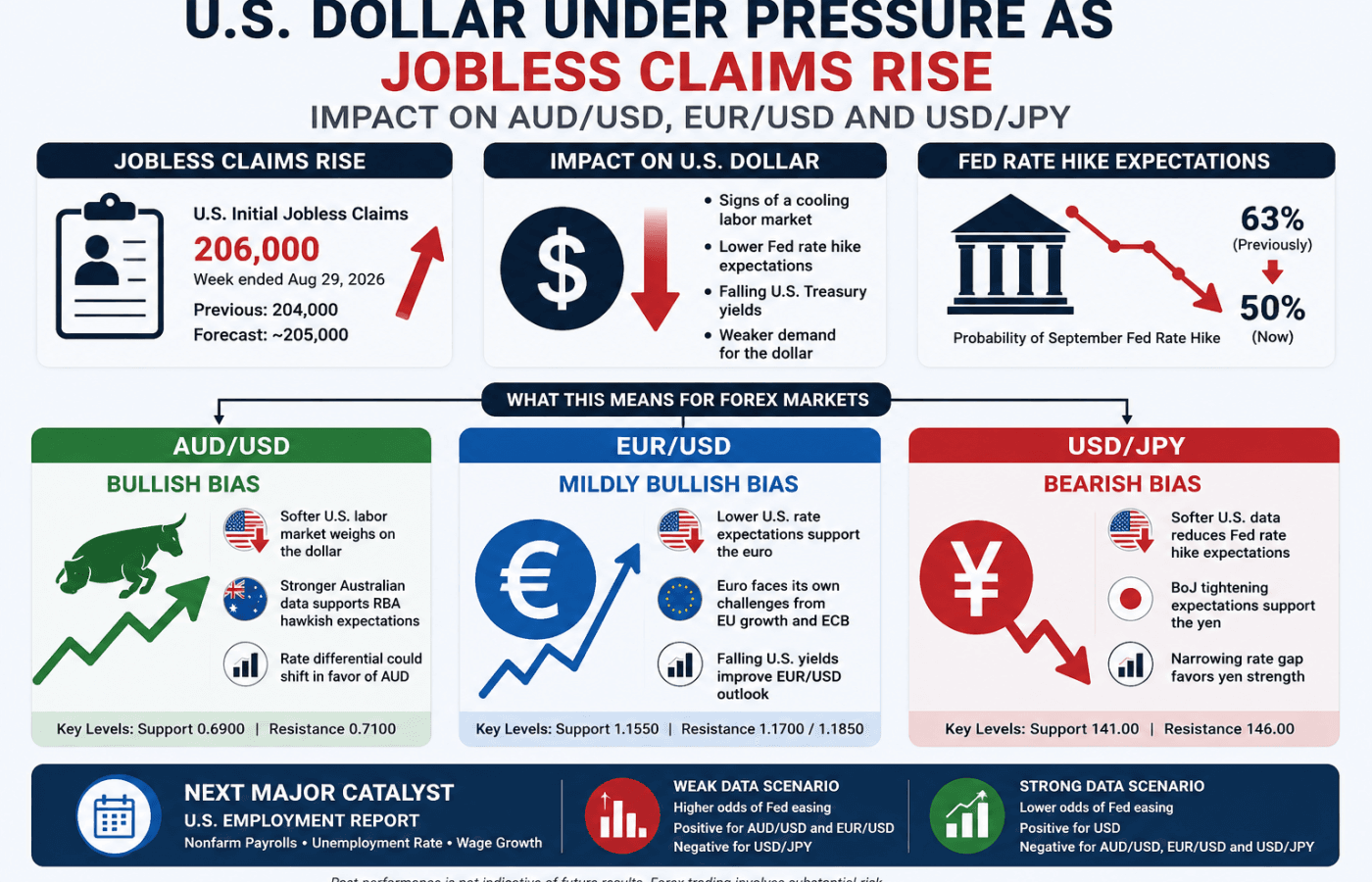
U.S. initial jobless claims increased to 206,000 in the week ended August 29, up from a revised 204,000 in the previous week. The figure was slightly above economists’ expectations of approximately 205,000. Continuing claims also increased by around 8,000 to approximately 1.78 million.
Although the increase in initial claims was relatively small, the data has attracted attention because financial markets are already highly focused on the direction of the U.S. labor market and what it could mean for Federal Reserve monetary policy.
The latest figures do not indicate a sudden collapse in American employment. Initial claims remain historically low. However, the combination of modestly higher claims, slower hiring and increasing sensitivity to labor-market weakness has encouraged traders to reassess the outlook for U.S. interest rates and the dollar.
Why Rising Jobless Claims Matter for the U.S. Dollar
Employment data is one of the most important factors influencing expectations for Federal Reserve policy. A strong labor market generally supports economic growth because people who remain employed continue to earn income and spend money.
Strong employment can also give the Federal Reserve more flexibility to maintain relatively high interest rates when inflation remains a concern. Higher U.S. interest rates can increase demand for the dollar because international investors may seek the comparatively higher yields available from U.S. assets.
The relationship can work in the opposite direction when employment conditions weaken.
If jobless claims begin rising consistently, investors may become concerned that companies are reducing hiring or increasing layoffs. A sustained deterioration in the labor market could eventually slow consumer spending and economic growth.
That could encourage the Federal Reserve to adopt a less restrictive monetary-policy stance.
For the foreign-exchange market, expectations of lower U.S. interest rates can reduce the attractiveness of the dollar relative to currencies whose central banks are expected to maintain or increase interest rates.
It is therefore important to understand that the latest jobless-claims figure is not significant because 206,000 represents an extremely high number. It does not. The importance comes from the possibility that the latest increase forms part of a broader cooling trend in the U.S. labor market.
Federal Reserve Expectations Remain Critical
The dollar’s reaction to employment data is increasingly being determined by expectations surrounding the Federal Reserve.
Investors are closely monitoring whether the U.S. central bank will maintain its current policy stance or move toward monetary easing if economic conditions weaken further.
Recent comments from Federal Reserve officials have added to market uncertainty. Policymakers are attempting to balance two competing risks: keeping monetary policy restrictive enough to control inflation while avoiding excessive pressure on employment and economic growth.
This creates a challenging environment for the U.S. dollar.
If inflation remains stubbornly high, the Federal Reserve may have less room to reduce interest rates. However, if employment conditions deteriorate more rapidly, policymakers could become more concerned about the labor market and become more willing to support economic activity.
For this reason, traders are likely to pay close attention to every major employment release over the coming weeks.
AUD/USD Outlook: Dollar Weakness Supports the Australian Dollar
The latest U.S. labor-market developments are generally supportive of AUD/USD.
The pair measures the value of the Australian dollar against the U.S. dollar. Therefore, when the U.S. dollar weakens, AUD/USD can move higher if the Australian dollar remains stable or strengthens.
The Australian dollar is also being influenced by expectations surrounding the Reserve Bank of Australia. Australian inflation, consumer spending and economic activity remain important factors in determining whether the RBA will maintain a relatively restrictive monetary-policy stance.
This creates an important contrast between the two currencies.
If markets become increasingly convinced that the Federal Reserve will eventually reduce interest rates while expectations for Australian interest rates remain comparatively firm, the interest-rate differential could become more favorable for the Australian dollar.
That would provide an additional fundamental reason for AUD/USD to move higher.
From the current fundamental perspective, therefore, AUD/USD has a mildly bullish bias.
However, traders should not interpret the latest U.S. jobless-claims data as an automatic buy signal. The Australian dollar is highly sensitive to global risk sentiment, commodity prices and developments in the Chinese economy.
A significant deterioration in global risk appetite could weaken AUD/USD even if the U.S. dollar is facing pressure from employment data.
The next major test for AUD/USD will be whether additional U.S. economic data confirms that the American labor market is losing momentum.
EUR/USD Outlook: Euro Buyers Could Benefit From Dollar Weakness
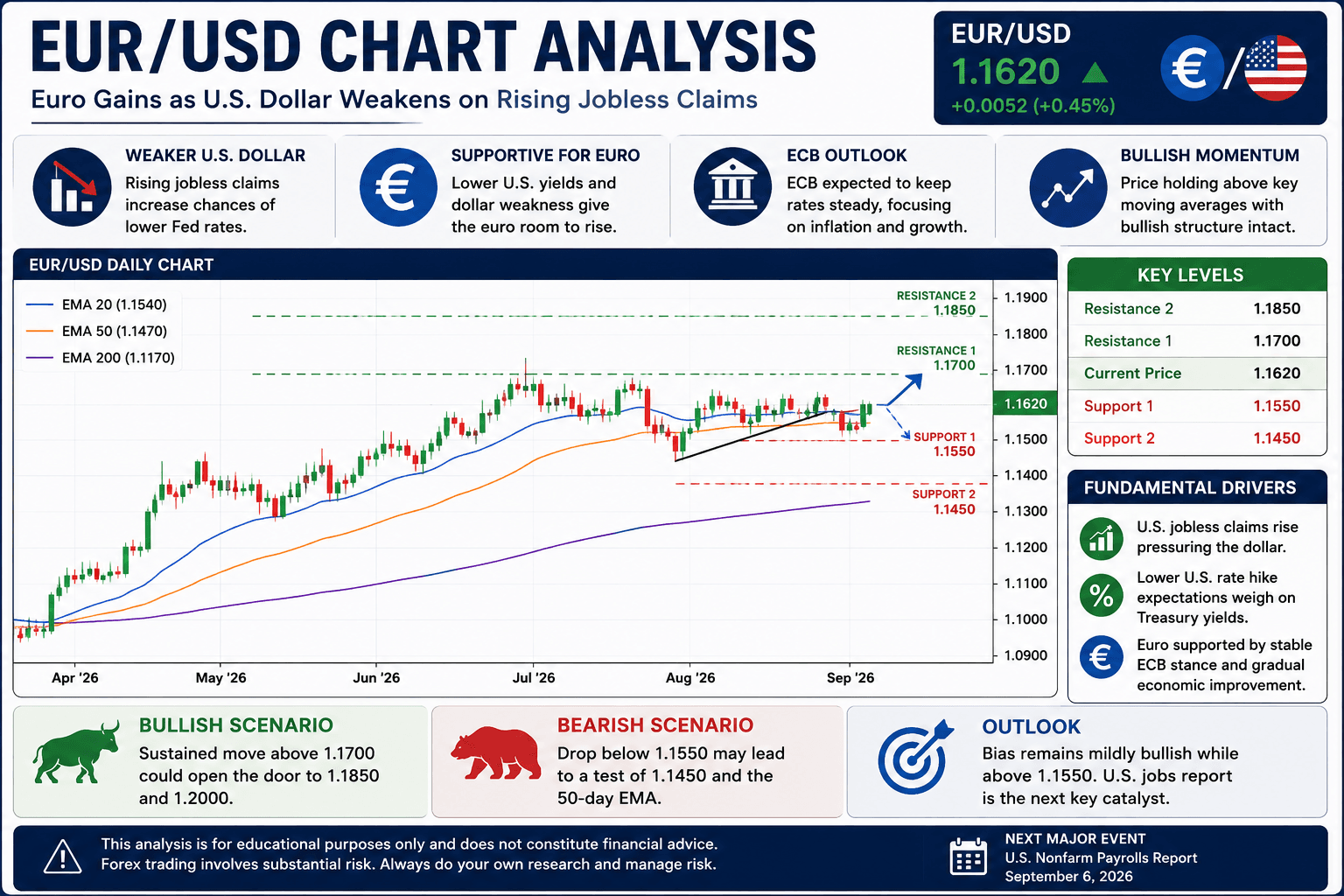
EUR/USD is also positioned to benefit from a softer U.S. dollar if expectations for Federal Reserve policy continue to shift.
The euro-dollar pair is particularly sensitive to changes in interest-rate expectations because investors constantly compare the expected returns available from euro-denominated and dollar-denominated assets.
If U.S. economic data weakens and markets begin expecting lower Federal Reserve interest rates, U.S. Treasury yields could come under pressure. Lower yields can reduce demand for the dollar and create a more supportive environment for EUR/USD.
However, the euro has its own fundamental challenges.
European economic growth, inflation, energy prices and European Central Bank policy will continue to influence the pair. A weak European economy could limit the euro’s ability to gain even if the dollar is under pressure.
This means the bullish argument for EUR/USD is currently based primarily on the changing U.S. monetary-policy outlook rather than on overwhelming strength in the European economy.
From a fundamental perspective, EUR/USD has a mildly bullish bias as long as U.S. economic data continues to disappoint or show signs of cooling.
A strong U.S. employment report, however, could quickly change this outlook by increasing expectations that the Federal Reserve will maintain restrictive policy for longer.
USD/JPY Outlook: Yen Strength Adds Pressure to the Dollar
For the Japanese currency, the standard forex pair is USD/JPY, rather than JPY/USD. When USD/JPY falls, it means the Japanese yen is strengthening against the U.S. dollar.
The latest U.S. labor-market data is particularly important for USD/JPY because the pair is being influenced by monetary-policy expectations in both countries.
On the U.S. side, weaker employment conditions can reduce expectations for higher Federal Reserve interest rates.
On the Japanese side, expectations for further monetary-policy normalization by the Bank of Japan can support the yen.
This creates a potentially powerful combination for yen bulls.
If U.S. Treasury yields decline while Japanese interest rates are expected to rise, the interest-rate gap between the two countries can narrow. This reduces one of the major advantages of holding the U.S. dollar against the yen.
The yen has recently shown signs of strengthening as investors reassess the outlook for Japanese monetary policy. Expectations that the Bank of Japan could continue moving away from its long period of ultra-loose monetary policy have provided additional support for the currency.
As a result, the current fundamental picture gives USD/JPY a bearish bias.
In practical terms, that means the fundamental environment currently favors yen strength and therefore creates downside pressure on USD/JPY.
Nevertheless, USD/JPY remains highly sensitive to U.S. employment data. A surprisingly strong U.S. jobs report could trigger a sharp rebound in Treasury yields and the dollar, potentially reversing the pair’s recent decline.
The U.S. Employment Report Is the Next Major Catalyst
The latest jobless-claims data is important, but it is unlikely to determine the medium-term direction of the dollar by itself.
The bigger test is the broader U.S. employment report, particularly nonfarm payrolls, the unemployment rate and wage growth.
These indicators can provide a much clearer picture of whether the U.S. labor market is genuinely weakening or simply experiencing normal weekly fluctuations.
A weak employment report would strengthen the argument that the Federal Reserve may need to become more supportive of economic activity.
If payroll growth falls significantly below expectations, unemployment rises and wage growth slows, traders could increase expectations for Federal Reserve easing.
Such an outcome would likely be negative for the U.S. dollar.
In that scenario, AUD/USD and EUR/USD could receive additional upward momentum, while USD/JPY could face further downside pressure.
On the other hand, a strong employment report could produce the opposite reaction.
If payroll growth significantly exceeds expectations and wage growth remains firm, traders could reduce expectations for Federal Reserve easing. Treasury yields could rise, potentially strengthening the U.S. dollar across the major currency pairs.
Current Fundamental Direction
The latest U.S. labor-market developments create the following broad fundamental picture for the three major forex pairs:
- AUD/USD: Mildly bullish bias. A weaker U.S. dollar and expectations surrounding Australian monetary policy provide support, although global risk sentiment and commodity markets remain important.
- EUR/USD: Mildly bullish bias. Reduced expectations for aggressive Federal Reserve policy can support the euro, although European economic conditions remain a significant factor.
- USD/JPY: Bearish bias. Softer U.S. labor-market expectations combined with increasing expectations for Japanese monetary-policy normalization favor yen strength.
These are fundamental directional biases rather than guaranteed trading signals. Forex prices can move sharply when economic data differs from expectations, and technical levels should be considered before entering any position.
Why Traders Should Not Overreact to the Latest Claims Figure
Although the dollar reacted to the latest labor-market information, traders should avoid interpreting the report as evidence that the U.S. economy is suddenly entering a severe downturn.
Initial claims remain relatively low by historical standards. The increase from 204,000 to 206,000 is small and could easily be reversed in a subsequent weekly report.
The more important issue is the longer-term trend.
If claims continue increasing over several weeks, continuing claims remain elevated and payroll growth weakens, the evidence of labor-market deterioration would become considerably stronger.
That would have much greater implications for Federal Reserve policy and the U.S. dollar.
Conversely, if claims fall again and employment growth rebounds, markets could conclude that the recent weakness was temporary.
This is why professional traders generally avoid relying on one economic indicator in isolation.
Dollar Outlook Going Forward
The U.S. dollar is currently facing a difficult fundamental environment.
Employment conditions are showing some signs of cooling, Federal Reserve policy expectations remain uncertain and investors are increasingly sensitive to any evidence that U.S. economic growth could slow.
At the same time, inflation remains an important obstacle to aggressive monetary easing. If price pressures remain elevated, the Federal Reserve may be reluctant to cut rates quickly even if employment growth slows.
This creates a situation where the dollar can experience significant volatility as markets constantly adjust the balance between inflation risks and employment risks.
For AUD/USD and EUR/USD, continued evidence of U.S. economic weakness would strengthen the bullish case.
For USD/JPY, the combination of weaker U.S. rate expectations and stronger expectations for Japanese monetary-policy normalization could continue supporting the yen.
Conclusion
The increase in U.S. jobless claims to 206,000 has added another sign that the American labor market may be gradually cooling, although the latest figure by itself does not represent a major deterioration in employment conditions.
The significance for the currency market comes from what the data could mean for Federal Reserve policy.
If the U.S. labor market continues to weaken, expectations for lower interest rates could increase, potentially placing further pressure on the dollar.
That environment would be broadly supportive of AUD/USD and EUR/USD, while potentially creating additional downside pressure on USD/JPY as the Japanese yen benefits from both dollar weakness and expectations for further Bank of Japan policy normalization.
However, traders should remain cautious. The next major U.S. employment figures could either confirm the current dollar weakness or completely reverse it.
The key takeaway for forex traders is that the dollar currently faces bearish fundamental pressure, but confirmation from the broader U.S. employment picture is necessary before treating the move as the beginning of a sustained downtrend.
This article is provided for financial education and market-analysis purposes only. It is not financial advice. Forex trading involves substantial risk, and traders should conduct their own analysis and use appropriate risk-management practices.