
Forex Market Outlook: Dollar, Yen, Euro and AUD/USD Forecast

Forex Markets Outlook: Dollar Weakness, Yen Strength and Shifting Central Bank Expectations
Forex markets are entering a potentially important phase as investors reassess the outlook for interest rates, inflation and monetary policy across the world’s major economies. The U.S. dollar remains under pressure despite signs of resilience in the latest U.S. employment data, while the Japanese yen has strengthened significantly as expectations for further Bank of Japan policy tightening increase.
At the same time, the euro is approaching an important technical area against the dollar, while the Australian dollar continues to attract attention amid stronger domestic economic signals and changing expectations surrounding Reserve Bank of Australia policy.
For forex traders, the current environment is being shaped by a combination of central bank expectations, inflation data, employment figures, bond yields and shifting risk sentiment. This means that individual currency pairs could experience significant volatility as markets react to incoming economic data.
The next major catalysts include U.S. inflation figures, European Central Bank policy decisions and further signals from the Bank of Japan. Together, these developments could help determine whether recent currency trends continue or begin to reverse.
Key Forex Market Developments
The foreign exchange market is currently being influenced by several major themes.
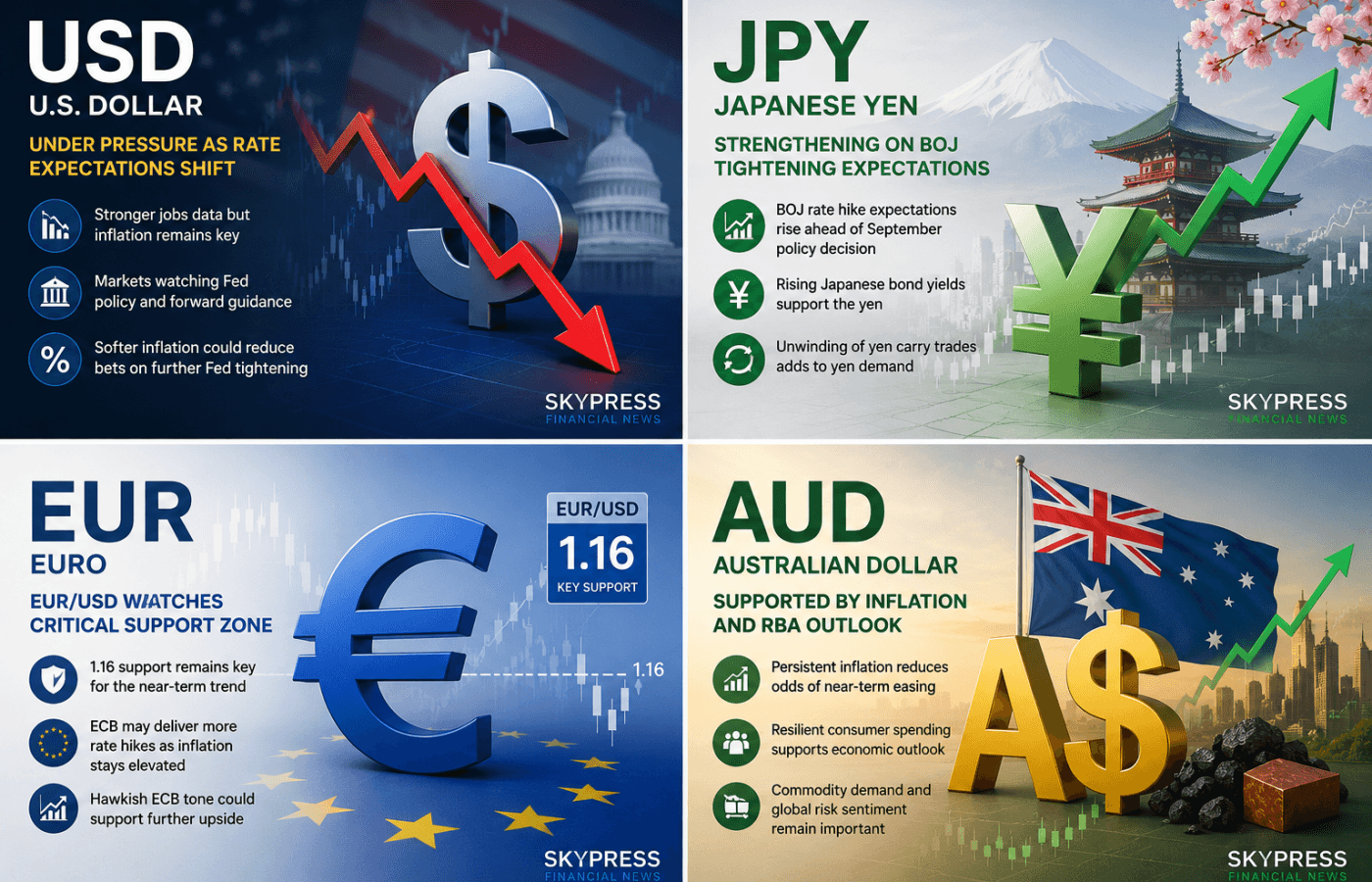
- U.S. Dollar: The dollar has struggled to establish a sustained recovery as traders reassess Federal Reserve interest-rate expectations.
- Japanese Yen: The yen has strengthened considerably, pushing USD/JPY lower as expectations for additional Bank of Japan tightening increase.
- Euro: EUR/USD is holding an important support area around the 1.16 region, placing upcoming ECB and U.S. economic data firmly in focus.
- Australian Dollar: The Australian dollar remains relatively resilient as domestic inflation and consumer spending influence expectations for Reserve Bank of Australia policy.
These developments highlight how closely currency markets remain tied to monetary policy. When traders expect interest rates to remain higher in one economy relative to another, capital flows can shift toward that currency. Conversely, expectations of lower rates can reduce demand for a currency by lowering its relative yield advantage.
U.S. Dollar Faces a Challenging Environment
The U.S. dollar remains one of the most closely watched currencies as markets attempt to determine the Federal Reserve’s next policy steps.
Recent U.S. employment data has provided some support for the dollar, but the broader recovery has remained limited. The market’s focus has increasingly shifted toward whether economic growth and inflation will justify a prolonged period of restrictive monetary policy.
Employment data is particularly important because the Federal Reserve has a dual mandate that includes maximum employment and price stability. Strong labor-market conditions can reduce the urgency for monetary easing, while signs of deterioration can strengthen expectations for lower interest rates.
The latest employment figures therefore provided some relief for the dollar. However, traders continue to assess the data alongside inflation trends, consumer activity and other indicators before forming stronger expectations about Federal Reserve policy.
Inflation will be especially important in the coming sessions. U.S. Consumer Price Index (CPI) and Producer Price Index (PPI) data could have a significant impact on Treasury yields, Federal Reserve expectations and the direction of the dollar.
A stronger-than-expected inflation reading could encourage traders to reduce expectations for aggressive monetary easing, potentially supporting the dollar. On the other hand, weaker inflation could reinforce expectations for lower interest rates and place additional pressure on the U.S. currency.
Why the Dollar’s Recovery Has Been Limited
One of the notable features of the current market is that positive U.S. economic news has not necessarily translated into a powerful and sustained dollar rally.
This suggests that currency traders may already be pricing in part of the improvement in U.S. economic conditions. It also demonstrates the importance of expectations in financial markets.
Currency prices do not simply respond to whether economic data and expectations are good or bad. Instead, traders compare the actual result with what the market had already anticipated.
For example, a strong employment report can initially strengthen the dollar. However, if traders had expected an even stronger result, the reaction may be limited. Similarly, weaker-than-expected inflation could produce a larger market reaction if investors had positioned themselves for a higher reading.
This dynamic is likely to remain important as markets move deeper into September.
Japanese Yen Strengthens as BOJ Expectations Increase
The Japanese yen has emerged as one of the most closely watched currencies in the current forex environment.
USD/JPY has moved lower toward the 155–157 region as traders increasingly consider the possibility of further monetary-policy tightening by the Bank of Japan.
The yen has historically been sensitive to changes in interest-rate differentials. Japan maintained extremely accommodative monetary policy for many years, while other major economies raised interest rates aggressively. This created an environment in which investors could borrow relatively cheaply in yen and invest in higher-yielding assets elsewhere.
That strategy is commonly associated with the yen carry trade.
When expectations change and Japanese interest rates are expected to rise, the attractiveness of holding short-yen positions can decline. Traders may then reduce carry trades, creating additional demand for the yen.
This can produce rapid movements in USD/JPY, particularly when Japanese monetary-policy signals arrive at the same time as changes in U.S. Treasury yields.
BOJ Policy Signals Remain Crucial
For yen traders, the Bank of Japan will remain a major source of potential volatility.
Markets are watching closely for signals regarding future interest-rate increases and the central bank’s assessment of inflation and economic growth.
If the BOJ adopts a more hawkish stance, the yen could receive additional support. However, if policymakers signal caution or emphasize downside risks to the Japanese economy, some of the recent yen gains could potentially unwind.
Traders should therefore avoid assuming that a stronger yen will continue in a straight line. Currency markets frequently experience sharp reversals when central-bank expectations change.
For USD/JPY specifically, the relationship between Federal Reserve expectations and BOJ expectations is likely to remain one of the most important drivers of the pair.
EUR/USD: Euro Holds a Critical Support Zone
At the same time, the EUR/USD pair is approaching an important technical area against the dollar, while the Australian dollar continues to attract attention amid stronger domestic economic signals and changing expectations surrounding Reserve Bank of Australia policy.
EUR/USD has been trading around the 1.16 area, making this region an important reference point for traders monitoring the pair’s medium-term direction. Recent technical analysis has highlighted the importance of this support area following the euro’s earlier advance.
The euro’s outlook is being influenced by two major factors: expectations surrounding European Central Bank monetary policy and the direction of the U.S. dollar.
On the European side, inflation has become increasingly important. Higher energy prices have contributed to renewed inflationary pressure across the euro area, creating a difficult environment for policymakers. At the same time, weaker consumer activity in major economies such as Germany has raised questions about the strength of economic growth.
This creates a complicated policy situation for the ECB. Persistent inflation can encourage tighter monetary policy, but weak economic growth can make policymakers more cautious about raising borrowing costs.
Markets are therefore watching the ECB’s upcoming policy decision closely. A more hawkish message could provide support for the euro, particularly if policymakers indicate that additional tightening could be required. A more cautious approach, however, could limit the euro’s upside.
EUR/USD Technical Picture
From a technical perspective, the 1.16 region remains an important area to monitor.
If EUR/USD can maintain support and attract renewed buying interest, traders could begin looking toward higher resistance levels. A sustained move above recent highs would strengthen the case for continued euro appreciation.
Conversely, a decisive break below the current support area could expose the pair to deeper downside pressure, particularly if U.S. economic data strengthens expectations for Federal Reserve tightening.
Traders should therefore watch the interaction between technical levels and fundamental catalysts rather than relying on either factor in isolation.
Australian Dollar Remains Supported by Domestic Inflation
The Australian dollar has also attracted attention as domestic economic conditions influence expectations surrounding Reserve Bank of Australia policy.
A key factor behind the Australian dollar’s recent resilience has been the persistence of inflationary pressure. Stronger-than-expected inflation can reduce expectations for near-term monetary easing and, in some circumstances, increase the probability of further rate increases.
Consumer spending and broader domestic economic activity are also important. A relatively resilient Australian economy can provide additional support for the currency by reducing expectations of rapid monetary-policy easing.
The Australian dollar is also particularly sensitive to global risk sentiment and commodity markets. Australia is a major exporter of commodities, meaning changes in global demand and commodity prices can influence the country’s trade outlook and currency valuation.
AUD/USD Outlook
AUD/USD remains caught between two major forces.
On one side, stronger Australian inflation and a potentially more hawkish RBA could support the Australian dollar. On the other, a renewed U.S. dollar rally could place downward pressure on the pair.
Recent market analysis has suggested that a combination of RBA tightening expectations and continued U.S. dollar weakness could allow AUD/USD to challenge higher levels. However, a stronger U.S. dollar around the Federal Reserve’s September meeting could reverse some of the Australian dollar’s recent gains.
For traders, the important issue is therefore not simply whether AUD/USD is bullish or bearish. Instead, attention should be given to whether the relative monetary-policy outlook between Australia and the United States continues to favor the Australian dollar.
Major Economic Events to Watch
The coming sessions could be particularly important for currency markets because several high-impact economic and central-bank events are scheduled within a relatively short period.
U.S. Consumer Price Index
U.S. CPI data is one of the most important events on the immediate forex calendar.
The inflation report could influence expectations surrounding the Federal Reserve’s September policy decision. A stronger-than-expected inflation reading could increase expectations for tighter monetary policy and potentially support the dollar.
Conversely, softer inflation could reinforce expectations that the Federal Reserve may have less need to tighten policy aggressively, potentially weighing on the dollar.
The reaction could extend beyond the dollar because changes in U.S. interest-rate expectations can affect Treasury yields, equity markets, commodities and other major currencies.
U.S. Producer Price Index
The Producer Price Index will provide another indication of price pressures within the U.S. economy.
Although PPI generally receives less attention from retail traders than CPI, it can provide useful information about input costs and potential future consumer-price pressures.
A combination of hotter-than-expected CPI and PPI could strengthen the case for continued Federal Reserve caution on monetary easing. Weaker readings could have the opposite effect.
European Central Bank Decision
The ECB’s September meeting is another major event for forex markets.
Markets are assessing the possibility of further tightening as inflationary pressures remain elevated. Current market expectations have pointed toward a potential 25-basis-point increase, although the policy outlook beyond that decision remains uncertain.
For EUR/USD traders, the rate decision itself may not be the only important factor. The ECB’s accompanying communication could be equally significant.
If policymakers signal that additional rate increases remain possible, the euro could receive support. If the ECB suggests that the tightening cycle is approaching its end, the market could interpret the decision as less supportive for the currency.
Bank of Japan Policy Signals
The Bank of Japan remains central to the outlook for the Japanese yen.
Japanese government bond yields have risen significantly, while expectations for a BOJ rate increase have strengthened. Recent market reporting indicates that traders are assigning a very high probability to a 25-basis-point BOJ increase at the September meeting.
Any indication that Japanese policymakers are prepared to accelerate monetary-policy normalization could increase demand for the yen and place further downward pressure on USD/JPY.
Market Volatility Could Increase
One of the most important considerations for forex traders over the coming weeks is the possibility of increased volatility.
Several major central banks are reassessing monetary policy at approximately the same time, while inflation and employment data continue to reshape interest-rate expectations.
This creates conditions in which currency pairs can experience sharp moves in both directions.
For example, a strong U.S. inflation report could initially trigger dollar buying. However, if subsequent Federal Reserve communication is less hawkish than expected, some of those gains could quickly disappear.
The same principle applies to the yen. Strong BOJ tightening expectations can support the currency, but if the actual policy decision is already fully priced into the market, the yen could experience a temporary sell-the-news reaction.
Traders should therefore distinguish between what the market expects and what actually happens. Currency prices often move most aggressively when there is a significant difference between the two.
Interest-Rate Expectations Remain the Main FX Driver
At the heart of the current forex outlook is the global interest-rate cycle.
The Federal Reserve, Bank of Japan, European Central Bank and Reserve Bank of Australia are all being watched for clues about the future path of interest rates.
Differences between central-bank policies can create substantial movements in currency pairs.
For example, if U.S. rates are expected to remain significantly higher than Japanese rates, investors may continue to favor the dollar over the yen. But if the BOJ becomes more aggressive while expectations for U.S. monetary tightening decline, the interest-rate gap can narrow and support the yen.
The same concept applies to EUR/USD and AUD/USD.
This means that traders should continue monitoring central-bank communication alongside economic data rather than focusing exclusively on price charts.
Expected Market Outlook in the Weeks Ahead
The forex market could remain highly sensitive to economic data and central-bank communication throughout the coming weeks.
The U.S. dollar: The near-term dollar outlook remains mixed. Strong employment data can provide temporary support, but the currency remains vulnerable if inflation data weakens and markets reduce expectations for further Federal Reserve tightening. Current analyst expectations suggest that the dollar could remain firm in the short term while facing greater downside risks over a longer horizon.
The Japanese yen: The yen has one of the most important potential catalysts ahead. Stronger BOJ tightening expectations, higher Japanese bond yields and the unwinding of carry trades could continue to support the currency. Recent reporting has highlighted a significant shift in yen positioning and expectations for further BOJ rate increases.
EUR/USD: The euro could remain sensitive to the combination of ECB policy and U.S. inflation. If the ECB maintains a hawkish stance while U.S. inflation moderates, EUR/USD could find renewed upward momentum. However, a stronger U.S. inflation reading combined with higher Treasury yields could place renewed pressure on the pair.
AUD/USD: The Australian dollar could remain relatively resilient if domestic inflation continues to keep RBA tightening expectations alive. However, the pair remains vulnerable to a broad-based dollar recovery, particularly if U.S. economic data causes markets to reassess Federal Reserve policy.
Overall, the weeks ahead are likely to be characterized by policy divergence, changing interest-rate expectations and elevated sensitivity to economic data.
Rather than expecting currencies to move consistently in one direction, traders should prepare for periods of strong momentum followed by sharp corrections as new information changes market expectations.
Major support and resistance levels will remain important, but fundamental catalysts could cause those technical levels to break quickly during high-impact economic announcements.
Accordingly, the broader market outlook should be viewed as a range of possible scenarios rather than a guaranteed prediction of future prices.
Key Takeaways
- The U.S. dollar remains under pressure despite some stronger economic data, with inflation and Federal Reserve policy expectations likely to determine its next major direction.
- The Japanese yen has strengthened as expectations for further BOJ tightening increase, while the unwinding of yen carry trades could add to volatility.
- EUR/USD is approaching an important decision point around the 1.16 region, with ECB policy and U.S. inflation likely to influence the next major move.
- AUD/USD remains supported by expectations surrounding Australian inflation and RBA policy, although renewed U.S. dollar strength could limit further gains.
- U.S. CPI and PPI are among the most important near-term economic releases because they can significantly alter Federal Reserve expectations.
- Central-bank policy divergence remains a major driver of forex markets. Traders should monitor the Fed, BOJ, ECB and RBA rather than analyzing individual currency pairs in isolation.
- Volatility could remain elevated in the weeks ahead as markets rapidly adjust to incoming economic data and central-bank communication.
- Technical levels should be combined with fundamental analysis. Major economic announcements can cause rapid breaks of support and resistance levels.
Conclusion
The global forex market is entering a period in which monetary policy could become even more important for currency valuations.
The U.S. dollar is facing competing forces from strong employment data and uncertainty over future Federal Reserve policy. Meanwhile, the Japanese yen is benefiting from rising expectations for BOJ tightening and changing carry-trade dynamics.
The euro and Australian dollar also have important domestic catalysts ahead, with ECB and RBA policy expectations likely to influence their respective currencies.
For forex traders, the most important lesson from the current environment is that market expectations can change quickly. A single inflation report, central-bank statement or unexpected economic development can alter interest-rate expectations and trigger significant movements across currency pairs.
As a result, traders should approach the coming weeks with disciplined risk management, avoid relying on a single forecast and remain prepared for both continuation and reversal scenarios.
The broader outlook remains highly dependent on incoming economic data. The interaction between inflation, employment, bond yields and central-bank policy will likely determine whether recent currency trends strengthen or begin to reverse.
SkyPress Financial Disclaimer
Disclaimer: The information provided in this article is for educational and informational purposes only and should not be considered financial, investment, trading or investment-management advice.
Forex trading involves substantial risk, including the possible loss of all or more of the capital allocated to a trade when leverage is used. Currency markets can be highly volatile, and past market performance or analysis does not guarantee future results.
The market outlook, scenarios and observations presented in this article represent analysis based on publicly available market information and should not be interpreted as a recommendation to buy, sell or hold any currency pair or financial instrument.
Before making any trading or investment decision, readers should conduct their own research and consider their financial circumstances, objectives and risk tolerance. Where appropriate, consult a qualified and independently licensed financial professional.
SkyPress does not guarantee the accuracy, completeness or timeliness of market forecasts or third-party information referenced in this article and accepts no responsibility for losses arising from decisions made based on the information presented.
Market conditions can change rapidly. Always verify current prices, economic data and central-bank announcements before making financial decisions.