
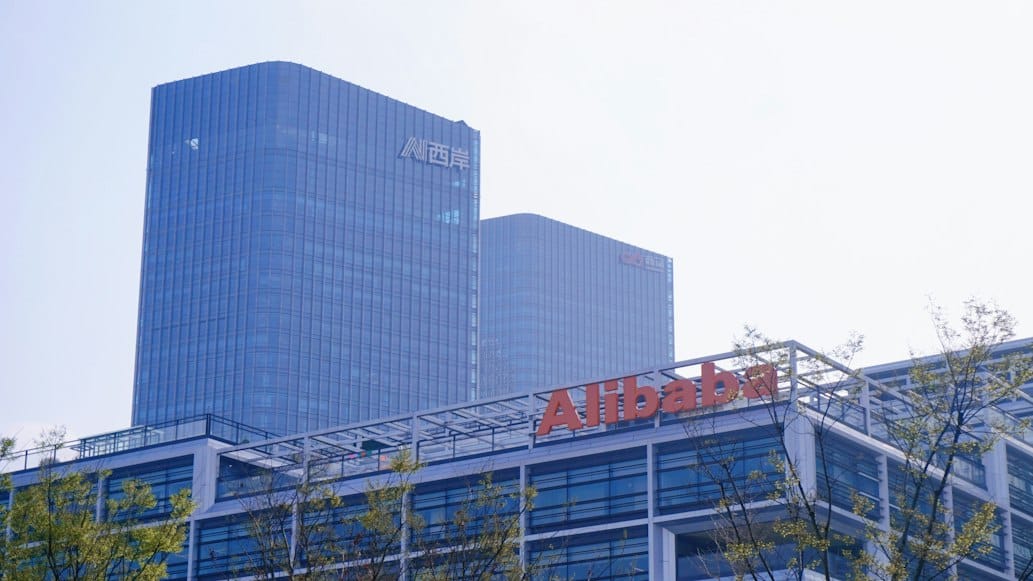
Alibaba Unveils New AI Chip as China Accelerates Its AI Infrastructure Push

Alibaba Unveils New AI Chip as China’s Tech Giant Plans Massive Expansion in AI Infrastructure
Alibaba Group is stepping up its artificial intelligence infrastructure ambitions, unveiling a new domestically developed AI accelerator while setting out plans to expand its global data-center capacity beyond 20 gigawatts by 2032.
By SkyPress Desk | SkyPress News
September 22, 2026
Key Takeaways
- Alibaba unveiled the Zhenwu V900 AI accelerator at the 2026 Apsara Conference in Hangzhou.
- Chief Executive Eddie Wu said the chip delivers three times the performance of its predecessor, the Zhenwu M890.
- Alibaba plans to expand its global data-center capacity beyond 20 gigawatts by 2032.
- The company is also working toward an AI model with between 5 trillion and 10 trillion parameters.
- Alibaba’s June-quarter results showed strong AI and cloud growth, but substantially higher technology investment contributed to a sharp decline in reported profit.
Alibaba Puts AI Infrastructure at the Center of Its Next Growth Phase
Alibaba Group has unveiled a new generation of artificial intelligence hardware and an ambitious expansion plan for its computing infrastructure, reinforcing the company’s strategy of building a full-stack AI ecosystem spanning chips, data centers, cloud computing and large language models.
The announcements were made by Alibaba Chief Executive Eddie Wu at the company’s 2026 Apsara Conference in Hangzhou on September 22. The annual technology event runs from September 22 to September 24 and is focused this year on developments across AI chips, cloud infrastructure, foundation models and agentic AI applications.
At the center of the announcement was Alibaba’s new Zhenwu V900 AI accelerator, developed by its semiconductor unit T-Head.
Wu described the V900 as the most powerful AI chip currently developed in China and said it delivers approximately three times the performance of the previous-generation Zhenwu M890.
According to Reuters’ reporting from the conference, Alibaba says the new accelerator can be deployed in clusters of as many as 500,000 chips for training advanced AI models. The company is positioning the processor as an important component of its broader effort to develop domestic computing capabilities.
A Major Data-Center Expansion Is Planned
The chip announcement is closely linked to Alibaba’s plans for a much larger computing infrastructure footprint.
Wu said Alibaba Cloud intends to operate more than 20 gigawatts of global data-center capacity by 2032, a target that illustrates the enormous amount of computing infrastructure the company expects to require as demand for AI services increases.
Chinese financial media reported that Wu cited exceptionally strong customer demand for AI computing as a major reason for the planned infrastructure expansion.
The strategy also follows Alibaba’s recent decision to direct substantial new capital toward AI infrastructure. In August, the company completed an HK$80 billion share placement and said approximately 60% of the proceeds would be used to expand global computing infrastructure, while roughly 40% would support hyperscale AI data centers and upgrades to cloud infrastructure.
This means Alibaba’s latest data-center target is not an isolated announcement. It forms part of a wider investment program aimed at increasing the computing resources available to its cloud and AI businesses.
Alibaba Targets AI Models With Up to 10 Trillion Parameters
Alibaba’s ambitions extend beyond hardware.
Wu also outlined plans to develop an AI model containing between 5 trillion and 10 trillion parameters, potentially placing the future system several times above the scale of Alibaba’s current flagship Qwen 3.8 Max model, which Reuters reported at 2.4 trillion parameters.
Parameters are numerical values learned during AI model training. While parameter count alone does not determine the usefulness or intelligence of a model, developing models at increasingly large scales requires enormous amounts of computing power, data, energy and infrastructure.
Reuters reported that Alibaba’s Qwen team is also exploring recursive self-improvement, an area of AI research involving systems that can contribute to improving their own capabilities.
The combination of larger models and increasingly sophisticated AI systems helps explain why Alibaba is simultaneously investing in chips, cloud infrastructure and data centers.
Qwen Remains a Major Part of Alibaba’s AI Strategy
Alibaba has increasingly positioned its Qwen model family at the center of its AI strategy.
The company has been expanding Qwen across language, coding, multimodal and enterprise applications while using Alibaba Cloud as the infrastructure layer through which customers can access AI computing and model services.
Alibaba’s June-quarter results provided evidence that the strategy is already generating significant demand.
For the quarter ended June 30, 2026, Alibaba reported revenue of approximately RMB268.95 billion, representing 9% year-over-year growth. Revenue from its AI Cloud and Compute Services segment reached approximately RMB48.44 billion, an increase of 45% from a year earlier.
Alibaba said AI-related product revenue had also recorded triple-digit growth for the twelfth consecutive quarter, highlighting the increasing contribution of AI-related demand to its cloud business.
The Cost of the AI Expansion
Alibaba’s aggressive AI investment, however, is coming with significant financial costs.
For the June quarter, net income attributable to ordinary shareholders fell to approximately RMB10.54 billion, while reported net income declined 75% year over year. The company attributed the decline to several factors, including lower operating income and investment-related changes, while its adjusted earnings were also affected by increased technology investment.
Capital expenditure increased sharply during the quarter, reaching approximately RMB67.68 billion, up 75% from the same period a year earlier. Alibaba said the increase was primarily associated with investment in AI infrastructure.
At the same time, the company’s AI and cloud operations showed substantial growth. Alibaba reported that AI Cloud and Compute Services revenue increased 45%, while adjusted EBITA for the segment rose 133% to approximately RMB5.63 billion.
The figures highlight an important feature of the current AI investment cycle: companies can experience rapid growth in AI-related revenue while simultaneously committing enormous amounts of capital to computing infrastructure.
China’s Push for Domestic AI Computing
Alibaba’s chip announcement also has significance beyond the company itself.
China’s technology industry has been investing heavily in domestically developed processors as access to some advanced foreign semiconductor technologies remains constrained by U.S. export controls.
The development of domestic AI accelerators has therefore become an important part of China’s broader technology strategy. Alibaba’s T-Head is among the companies working to develop computing hardware that can support large-scale AI workloads within the domestic technology ecosystem.
Reuters reported that the V900 launch comes amid China’s broader effort to develop alternatives to Nvidia’s processors and strengthen domestic AI computing capabilities.
The significance of the V900 will ultimately depend not only on its stated performance but also on production volumes, software compatibility, availability of advanced manufacturing capacity and the ability of Alibaba’s ecosystem to deploy the chip efficiently at scale.
Alibaba’s Cloud Business Could Become Increasingly Important
Alibaba’s latest strategy places its cloud business in an increasingly important position.
The company’s AI models require substantial computing resources, while enterprise customers using those models also need cloud infrastructure to deploy AI applications. This creates an opportunity for Alibaba to generate revenue at multiple layers of the AI ecosystem.
Its June-quarter results suggest that this model is already beginning to take shape. Alibaba Cloud’s external revenue growth accelerated, while AI-related demand contributed significantly to the performance of its cloud and computing business.
The company’s objective is therefore not simply to develop another AI model. Alibaba is attempting to control a broad portion of the infrastructure required to build, train, host and commercialize AI systems.
What the V900 Means for Alibaba’s AI Roadmap
The introduction of the Zhenwu V900 gives Alibaba another piece of infrastructure that could support its longer-term AI ambitions.
If the company’s stated performance figures are achieved in large-scale deployments, the accelerator could reduce Alibaba’s reliance on externally sourced AI computing hardware and provide greater control over the architecture used by its cloud and model businesses.
However, raw chip performance is only one part of the equation. Large AI systems require entire ecosystems involving processors, high-speed networking, memory, cooling systems, data-center power and software. Alibaba’s simultaneous investment across these areas suggests that it is approaching AI infrastructure as an integrated system rather than as a single-chip competition.
Alibaba Shares React to the AI Strategy
Alibaba’s Hong Kong-listed shares have recently been supported by renewed interest in Chinese technology and AI companies.
Alibaba shares closed at HK$112.60 on September 21, up 3.02% for the session, according to historical market data. The move came ahead of the Apsara Conference, where investors were expecting new information on Alibaba’s AI models, cloud infrastructure and chip strategy.
The market reaction to the latest announcements will depend on how investors assess the balance between Alibaba’s rapidly expanding AI-related revenues and the substantial capital required to support future growth.
The company’s recent share placement also demonstrates that funding AI infrastructure has become a major corporate priority. Alibaba said the proceeds would be directed toward expanding computing capacity and building hyperscale AI data centers.
The Bigger AI Infrastructure Race
Alibaba’s announcement comes during a period in which technology companies around the world are committing unprecedented resources to AI infrastructure.
AI model development increasingly requires large clusters of specialized processors, while commercial deployment requires additional computing capacity to handle inference workloads from businesses and consumers.
This is turning data centers, electricity supply, networking equipment, semiconductor manufacturing and cloud computing into increasingly important components of the AI economy.
For Alibaba, the objective is to build an integrated infrastructure platform capable of supporting its Qwen models and AI applications while also selling computing capacity to external customers through Alibaba Cloud.
The company’s plan to exceed 20 gigawatts of data-center capacity by 2032 shows the scale of infrastructure it believes will be necessary to support that strategy.
What Comes Next for Alibaba
Alibaba’s latest announcements mark another major step in its transformation into an AI-focused technology and cloud infrastructure company.
The Zhenwu V900, the planned multi-trillion-parameter AI models and the 20-gigawatt data-center target all point toward the same strategic objective: increasing Alibaba’s control over the computing infrastructure required for the next generation of artificial intelligence.
Whether those investments translate into sustained financial returns will depend on several factors, including AI customer demand, cloud monetization, model competitiveness, infrastructure costs and the company’s ability to improve the economics of large-scale AI deployment.
For now, Alibaba’s strategy is clear. The company is investing across the entire AI stack—from semiconductor hardware and data centers to cloud services and foundation models—as it seeks to establish a larger role in China’s rapidly expanding artificial intelligence economy.
SkyPress News Perspective
Alibaba’s latest announcements provide a useful illustration of how the AI race is moving beyond model development toward infrastructure. The company’s strategy combines chip development, cloud computing, data centers and AI models, while its financial results show the substantial investment required to build that ecosystem. The key issue for Alibaba over the coming years will be how effectively it converts growing AI demand into sustainable revenue and earnings while managing the cost of its infrastructure expansion.
Sources and Reporting Basis
This SkyPress News article was independently written using information reported by Reuters, Alibaba Group’s official financial disclosures, the U.S. Securities and Exchange Commission, official Alibaba Cloud information on the 2026 Apsara Conference, Hangzhou municipal government reporting, and additional financial-market reporting. The article does not reproduce the source articles and has been independently structured and written by SkyPress.
- Reuters — Reporting on Alibaba’s 5–10 trillion-parameter AI model, Zhenwu V900 and 20GW data-center strategy.
- Alibaba Group — June 2026 quarterly financial results and AI/cloud performance.
- U.S. SEC — Alibaba Group June-quarter 2026 results filing.
- Alibaba Cloud — 2026 Apsara Conference information and technology agenda.
- Hangzhou municipal government — 2026 Apsara Conference and AI technology developments.
Article Disclaimer
This article is provided for general news and informational purposes only. It does not constitute financial, investment, trading or other professional advice. Market prices can change rapidly, and readers should conduct their own research and consult qualified professionals before making financial decisions.
SkyPress News
Independent financial, business and economic news from SkyPress by Skyrexx.
© 2026 SkyPress by Skyrexx. All rights reserved.