
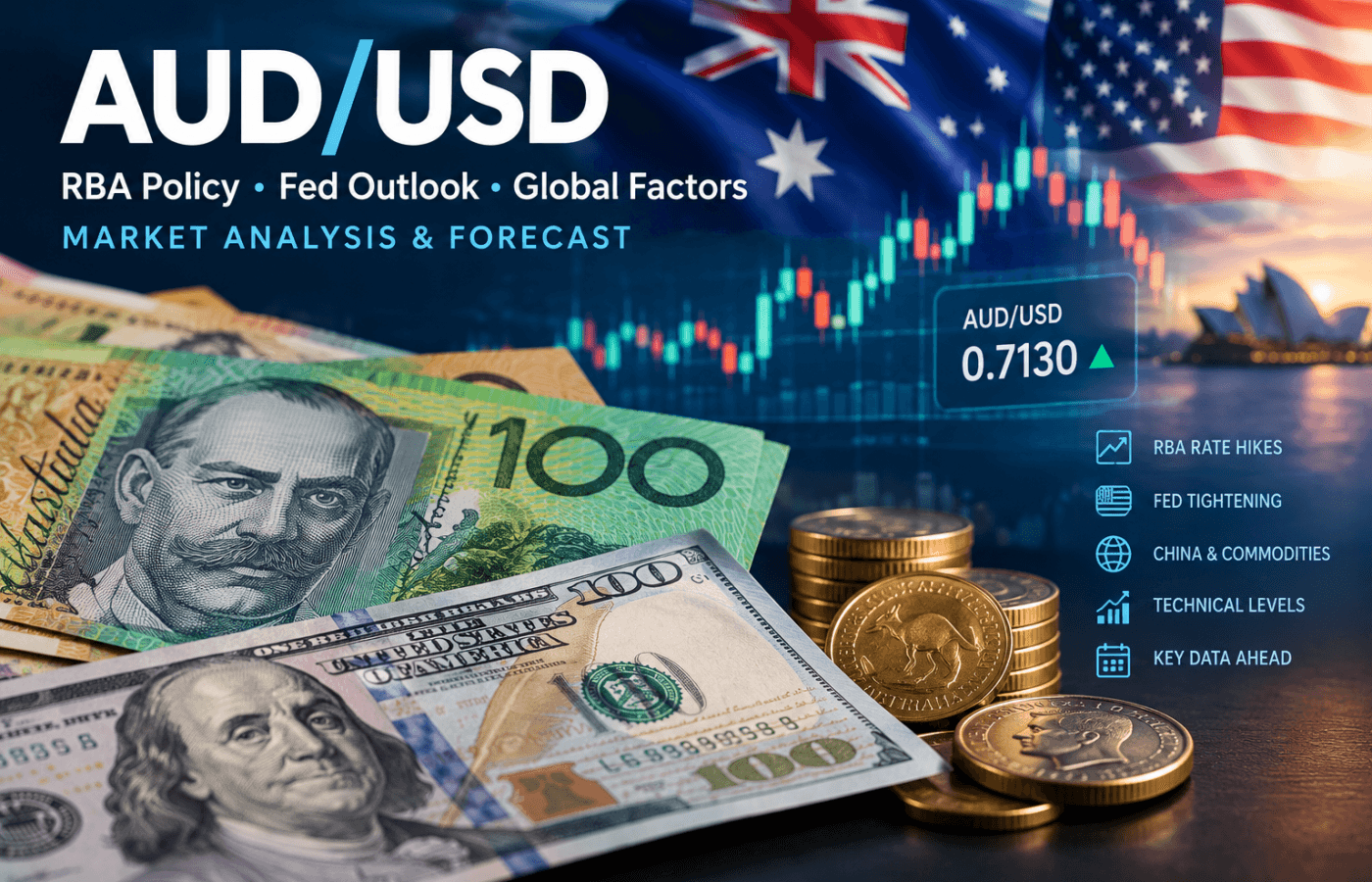
AUD/USD Outlook: Australian Dollar Holds Above 0.7100 as RBA Rate Bets Collide With Federal Reserve Hawkishness

Published: September 21, 2026
By SkyPress Desk | SkyPress News
AUD/USD Market Update: Australian Dollar Navigates Central Bank Policy and Global Risk
The Australian dollar is attempting to maintain its position above the 0.7100 level against the U.S. dollar as investors weigh renewed expectations of Reserve Bank of Australia interest rate increases against a more restrictive outlook from the Federal Reserve. The currency pair is entering a potentially important period, with Australian employment data, central bank commentary and developments in U.S.–China relations expected to influence market sentiment.
AUD/USD was trading around 0.7130 in Monday’s market commentary, according to FXStreet, while Westpac reported that the Australian dollar had started the week cautiously above 0.7100 after falling to a one-month low of 0.7075 during the previous week. The recovery reflects competing forces rather than a clear resolution of the pair’s directional outlook.
The Australian dollar has received support from growing expectations that the RBA could raise interest rates again at its September 29 meeting. At the same time, the U.S. dollar continues to benefit from expectations of further Federal Reserve tightening, while elevated Treasury yields and geopolitical uncertainty are limiting the scope for sustained gains in risk-sensitive currencies.
The result is a market in which the interest-rate differential between Australia and the United States, commodity prices, China’s economic outlook and broader investor risk appetite could all influence the next significant move in AUD/USD.
Australian Dollar Recovers as Markets Increase RBA Rate Hike Expectations
Australian monetary policy has become one of the central drivers of the Australian dollar’s near-term performance.
The RBA has already raised its official cash rate by 75 basis points during 2026 to 4.35%, according to reporting published by FXStreet on September 21. Governor Michele Bullock has also highlighted concerns about inflation risks, stating that upside risks remain and that policymakers must consider whether the tightening delivered so far will be sufficient to return inflation to target within a reasonable timeframe.
Westpac reported that markets were pricing an 80–90% probability of another 25-basis-point rate increase at the September 29 meeting. Such expectations can support the Australian dollar by increasing the potential return associated with Australian interest-bearing assets relative to alternatives.
However, rate hike expectations are not the same as a confirmed policy decision. The RBA’s actual decision will depend on incoming economic information, inflation developments, employment conditions and the central bank’s assessment of risks to economic activity.
Investors are therefore monitoring official commentary for indications of whether further tightening is becoming more likely or whether policymakers could adopt a more cautious approach.
Governor Bullock’s scheduled remarks, alongside other RBA speakers, are expected to provide additional information about the central bank’s policy assessment before the September meeting.
Why RBA Policy Matters for AUD/USD
Interest rates can influence currency valuations through several channels.
When investors expect Australian interest rates to rise, Australian assets may become more attractive relative to assets in countries where rates are expected to remain lower. This can contribute to demand for the Australian dollar.
The effect is not automatic. Currency markets also consider expected economic growth, inflation, global risk appetite, relative bond yields and whether a policy decision has already been reflected in exchange rates.
Consequently, an RBA rate increase that is widely anticipated may produce a limited currency reaction if it contains no significant surprise. Conversely, an unexpected policy signal can produce a stronger response.
For AUD/USD, the market’s reaction will depend not only on whether the RBA changes rates, but also on the tone of its accompanying communication and how that tone compares with expectations for Federal Reserve policy.
Federal Reserve Tightening Creates a Counterweight to the Australian Dollar
The Australian dollar’s recovery is taking place against a backdrop of renewed U.S. dollar support.
The Federal Reserve raised interest rates by 25 basis points during the previous week, according to Westpac’s September 21 market report. The move was accompanied by a firm policy message, while U.S. Treasury yields moved higher.
The 10-year Treasury yield briefly moved above 5%, according to Westpac, a development that contributed to pressure on risk-sensitive currencies earlier in the week.
Higher U.S. yields can increase the appeal of dollar-denominated assets, depending on the outlook for inflation, growth and monetary policy. When markets anticipate that U.S. interest rates will remain elevated, the U.S. dollar may receive support against currencies such as the Australian dollar.
The Federal Reserve’s policy trajectory is particularly important because AUD/USD is influenced by the relative outlook for Australian and American interest rates.
If investors increase expectations for further Federal Reserve rate increases while reducing expectations for RBA tightening, the interest-rate differential may move in favor of the U.S. dollar. This could create downward pressure on AUD/USD.
In contrast, if Australian inflation and employment data reinforce expectations of additional RBA rate increases while U.S. policy expectations become less restrictive, the Australian dollar could receive relative support.
The direction of the pair will therefore depend on how markets reassess the two central banks rather than on either central bank’s policy in isolation.
AUD/USD Trend: Recovery Attempt After September Pressure
The Australian dollar has experienced a period of significant movement during the third quarter of 2026.
Reuters reported on September 15 that AUD/USD had gained approximately 5% from late June to early September before coming under renewed pressure. The report identified a stronger U.S. dollar, rising U.S. Treasury yields and concerns about global risk appetite as factors weighing on the Australian currency.
The pair reached a recent high around 0.7238 on September 9, according to technical market analysis published by Reuters and FXStreet. It subsequently moved lower, with the decline bringing the 0.7100 region back into focus.
This pattern illustrates the changing balance between the Australian dollar’s earlier appreciation and the subsequent recovery in U.S. dollar demand.
The Australian dollar is often treated by market participants as a currency sensitive to global economic conditions and investor risk appetite. When expectations for global growth improve, demand for currencies associated with commodities and international trade can increase. When investors become more defensive, the U.S. dollar may benefit from its role in global financial markets.
Nevertheless, the relationship is not constant. Interest rates, commodity prices, domestic economic developments and market positioning can alter the way AUD/USD responds to changes in sentiment.
Recent Trading Range and Technical Observations
FXStreet’s September 21 analysis indicated that AUD/USD was holding above the 100-day simple moving average near 0.7078. The analysis also identified the 0.7095 region as a retracement reference and resistance around 0.7149, followed by the recent high near 0.7237.
A separate intraday analysis identified resistance near 0.7140 and 0.7147, with support around 0.7120, 0.7105 and 0.7075.
The differences between these levels reflect the use of different chart timeframes and analytical methods.
Technical levels should not be interpreted as fixed barriers. Exchange rates can move through them during periods of strong buying or selling pressure, especially when economic data, central bank announcements or geopolitical developments create unexpected market reactions.
China and Commodity Markets Remain Important to AUD/USD
The Australian dollar’s future direction is also closely connected to developments outside Australia and the United States.
China is a major trading partner for Australia, and changes in China’s economic activity can influence expectations for Australian exports, commodity demand and broader regional growth.
Developments in the U.S.–China relationship are therefore relevant to the Australian dollar, particularly when trade restrictions, tariffs or diplomatic developments affect investor expectations.
Markets are monitoring a scheduled meeting between U.S. President Donald Trump and Chinese President Xi Jinping later in the week. Westpac identified the meeting and developments surrounding China as important considerations for the Australian dollar.
The implications for AUD/USD will depend on the substance of any announcements and the extent to which investors believe they could affect trade, economic activity and market confidence.
Commodity Prices and the Australian Dollar
Australia’s export exposure to commodities is another factor that can influence the currency.
Energy market developments have recently affected investor sentiment. Westpac reported that Brent crude had approached US$110 per barrel during the previous week amid attacks on Saudi energy infrastructure before retreating as concerns about the extent of the damage eased.
Higher energy prices can have different effects on currencies depending on the underlying circumstances. They may contribute to inflation concerns, influence central bank policy expectations and alter perceptions of economic growth.
For the Australian dollar, commodity market developments can interact with domestic economic conditions and global risk sentiment. However, AUD/USD should not be treated as a simple one-to-one indicator of oil or commodity prices.
The pair’s response will depend on how investors assess the effect of commodity movements on Australian growth, inflation, international trade and relative monetary policy.
AUD/USD Forecast: What Could Shape the Pair’s Next Direction?
The near-term outlook for AUD/USD is being shaped by a combination of potentially supportive Australian factors and countervailing U.S. dollar strength.
There is no single confirmed future direction. Instead, the market is assessing several possible developments that could change the balance between the two currencies.
RBA Tightening Expectations Could Support AUD/USD
If Australian employment data remains resilient and inflation concerns continue to support expectations of further RBA rate increases, the Australian dollar could receive support.
A stronger-than-expected employment report may encourage investors to maintain or increase expectations for tighter monetary policy. Depending on the scale of the surprise, this could strengthen demand for the Australian dollar.
However, the response would also depend on how much of the anticipated policy tightening is already reflected in the exchange rate.
Continued Federal Reserve Hawkishness Could Limit Australian Dollar Gains
A Federal Reserve that maintains a restrictive policy stance could continue to support the U.S. dollar.
If U.S. inflation remains elevated or policymakers signal that interest rates may need to stay higher for longer, Treasury yields and dollar demand could receive additional support.
This could make it more difficult for AUD/USD to sustain advances, particularly if global investors reduce exposure to risk-sensitive currencies.
The magnitude of any move would depend on the difference between actual developments and prevailing market expectations.
China-Related Developments Could Influence Investor Sentiment
China-related economic and trade developments may contribute to fluctuations in the Australian dollar.
Improving expectations for Chinese economic activity or reduced trade uncertainty could support risk appetite and potentially benefit AUD/USD.
In contrast, renewed concerns about trade restrictions, economic weakness or broader global growth could create pressure on currencies exposed to international economic conditions.
The market reaction would depend on the nature of the development and whether investors interpreted it as temporary or likely to affect economic conditions over a longer period.
Continue to Part 2: Upcoming economic events, technical scenarios, market risks, conclusion, key takeaways, FAQs, disclaimer and sources.
Key Economic Events to Monitor This Week
The upcoming economic calendar contains several events that could influence AUD/USD.
Tuesday, September 22
- RBA Governor Michele Bullock’s scheduled fireside chat.
- Commentary from RBA Assistant Governor Hunter.
- Further Federal Reserve speaker appearances.
Investors will look for indications about the RBA’s assessment of inflation and the potential direction of monetary policy.
Wednesday, September 23
- Preliminary September purchasing managers’ index readings for Australia, the United Kingdom, the eurozone and the United States.
The PMI data may provide information about business activity and economic momentum across major economies.
Thursday, September 24
- Australia’s August labor force report.
- Developments surrounding the scheduled Trump–Xi meeting.
- Further Federal Reserve commentary.
The Australian employment report is a major domestic data event because labor market conditions can influence expectations for RBA policy.
Friday, September 25
- Final University of Michigan consumer survey data for the United States.
- Additional developments in financial markets and monetary policy expectations.
The market response to economic data will depend on the extent to which actual results differ from expectations.
Technical Scenarios: Important Levels for Market Observation
Technical analysis offers a framework for monitoring price behavior, but it does not establish a guaranteed outcome.
The following levels are drawn from published market commentary and should be treated as reference points rather than trading instructions.
Potential Upside Reference Points
The 0.7140–0.7149 region represents an initial area to monitor if AUD/USD maintains its recovery above 0.7100.
A sustained move through this area could bring the 0.7188 region into focus, followed by the recent swing high near 0.7237–0.7238.
A move toward these levels would not, by itself, confirm a sustained uptrend. Market participants would need to assess whether the advance is supported by broader changes in monetary policy expectations, market sentiment and price structure.
Potential Downside Reference Points
The 0.7100 region remains an important psychological reference point.
FXStreet identified the 0.7095 area as a retracement reference and the 0.7078 region as the 100-day simple moving average. Westpac reported a recent low around 0.7075.
A sustained decline through these areas could bring deeper retracement levels into consideration, including the 0.7051 and 0.7007 areas identified in FXStreet’s technical analysis.
Technical levels can be invalidated by changes in market conditions, and price movements around economic announcements may be volatile.
Why Confirmation Matters
A price movement through a technical level does not automatically establish a new trend.
Analysts may consider the duration of a move, trading volume where relevant, momentum indicators, broader market conditions and whether the price remains above or below important reference points.
The technical analysis published by Reuters on September 15 highlighted the importance of the 0.7180 area as a level that could challenge its then-bearish technical assessment. FXStreet’s September 21 report presented a more cautious setup, with the pair holding above its 100-day moving average while momentum indicators remained mixed.
These observations demonstrate why different analyses may reach different conclusions depending on the timeframe and assumptions used.
Risks That Could Disrupt the AUD/USD Outlook
Currency markets remain exposed to developments that cannot always be anticipated with precision.
1. Unexpected Central Bank Decisions
An unexpected change in RBA or Federal Reserve policy expectations could lead to a rapid repricing of the pair.
Market participants may respond to the policy decision itself, the accompanying statement, official projections or subsequent comments from policymakers.
2. Inflation Surprises
Higher-than-expected inflation in Australia or the United States could alter interest rate expectations.
The effect on AUD/USD would depend on which country’s inflation outlook changes more significantly and how markets interpret the likely policy response.
3. Geopolitical and Energy Market Developments
Geopolitical tensions can affect the U.S. dollar, commodity prices and investor risk appetite.
A sudden increase in uncertainty may generate demand for defensive assets, while an improvement in sentiment may support risk-sensitive currencies.
The Australian dollar’s response will depend on the specific event and its perceived economic consequences.
4. Chinese Economic and Trade Developments
Changes in China’s growth outlook or trade policy could influence expectations for Australia’s external economic conditions.
The currency response would depend on whether the development is viewed as supportive or negative for regional trade and global growth.
Conclusion: AUD/USD Enters a Data-Dependent Phase
AUD/USD is navigating competing monetary policy signals as expectations for further RBA tightening provide support for the Australian dollar while Federal Reserve hawkishness and U.S. Treasury yields continue to influence the U.S. dollar.
The pair’s position above 0.7100 is being watched alongside technical reference levels around 0.7140–0.7149 on the upside and 0.7075–0.7078 on the downside.
The next major developments include RBA commentary, Australian employment data, U.S. monetary policy signals and the scheduled U.S.–China meeting. These events may influence expectations for interest rates, economic activity and global investor sentiment.
The future direction of AUD/USD will depend on how these factors evolve and how markets reassess the relative outlook for Australia and the United States. Neither technical reference levels nor current rate expectations can guarantee the pair’s next move.
For financial market observers, the key consideration is the interaction between domestic Australian economic resilience, Federal Reserve policy, China-related developments and broader global risk appetite.
Key Takeaways
- AUD/USD is holding above the 0.7100 area following recent selling pressure.
- Expectations of another RBA rate increase have provided support for the Australian dollar.
- Federal Reserve tightening expectations and higher U.S. Treasury yields remain potential sources of U.S. dollar strength.
- China-related developments and commodity market conditions are relevant external influences.
- Australian employment data and central bank commentary are among the key upcoming events.
- Technical levels provide market reference points but do not guarantee future price movements.
Frequently Asked Questions
What Is Currently Influencing AUD/USD?
The main reported influences include RBA rate hike expectations, Federal Reserve policy, U.S. Treasury yields, global risk sentiment, commodity markets and China-related developments.
Could the Australian Dollar Strengthen Against the U.S. Dollar?
A stronger Australian dollar is one possible outcome if expectations for Australian monetary policy and economic conditions become more supportive relative to the United States. However, the direction will depend on incoming data and changing market expectations.
Why Is the Federal Reserve Important for AUD/USD?
The Federal Reserve influences U.S. interest rates and financial conditions. Changes in expectations for U.S. monetary policy can affect the relative attractiveness of dollar-denominated assets and the exchange rate.
Why Does China Matter to the Australian Dollar?
China is an important trading partner for Australia. Developments affecting Chinese economic activity and trade can influence expectations for Australia’s export demand and broader economic conditions.
Are the Technical Levels a Guaranteed Forecast?
No. Technical levels are analytical reference points. They can be breached or become less relevant when economic data, policy decisions or market sentiment changes.
Article Disclaimer
This article is published by SkyPress for educational and informational purposes. It is not financial, investment, forex trading or other professional advice. Currency markets involve substantial risk, and past price movements do not guarantee future results. Readers should conduct independent research and consider consulting a qualified financial professional before making financial decisions.
Sources
- FXStreet — AUD/USD Price Forecast: Holds comfortably above 0.7100 as bulls await Trump-Xi meeting
- FXStreet — Australian Dollar firms on RBA hike bets ahead of Bullock, jobs data
- Westpac IQ — Australian Dollar Steadies Above 0.7100 as Oil Retreats
- Reuters — Mapping the Market: Australian dollar in trouble as bearish pressure mounts
Editorial note: Market figures and event expectations reflect the cited reporting available on September 21, 2026. Prices and forecasts can change after publication.
Discover More from SkyPress
Discover More